
SAFETY INFORMATION
| Signal word | Danger |
|---|---|
| Pictogram(s) |
 Flame Flammables GHS02  Skull and Crossbones Acute Toxicity GHS06  Health Hazard GHS08 |
| GHS Hazard Statements |
H225:Flammable liquids H370:Specific target organ toxicity, single exposure |
| Precautionary Statement Codes |
P210:Keep away from heat/sparks/open flames/hot surfaces. — No smoking. P280:Wear protective gloves/protective clothing/eye protection/face protection. P370+P378:In case of fire: Use … for extinction. P403+P235:Store in a well-ventilated place. Keep cool. |
COMPUTED DESCRIPTORS
| Molecular Weight | 453.0 g/mol |
|---|---|
| Hydrogen Bond Donor Count | 1 |
| Hydrogen Bond Acceptor Count | 6 |
| Rotatable Bond Count | 9 |
| Exact Mass | 452.2302666 g/mol |
| Monoisotopic Mass | 452.2302666 g/mol |
| Topological Polar Surface Area | 81 Ų |
| Heavy Atom Count | 31 |
| Formal Charge | 0 |
| Complexity | 614 |
| Isotope Atom Count | 0 |
| Defined Atom Stereocenter Count | 0 |
| Undefined Atom Stereocenter Count | 0 |
| Defined Bond Stereocenter Count | 0 |
| Undefined Bond Stereocenter Count | 0 |
| Covalently-Bonded Unit Count | 2 |
| Compound Is Canonicalized | Yes |
PRODUCT INTRODUCTION
description
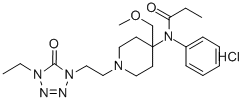
Alfentanil Hydrochloride is the hydrochloride salt of alfentanil, a synthetic short-acting opioid with analgesic and local anesthesia enhancing activity. Alfentanil primarily binds to mu-opioid receptor, a G-protein-coupled receptor, thereby mimicking the actions of morphine, the prototypical mu receptor agonist. This agent induces anti-nociception responses mediated through inhibiting the release of various neurotransmitters such as substance P, GABA, dopamine, acetylcholine and noradrenaline; in addition, the release of vasopressin, somatostatin, insulin and glucagon are also inhibited.