
62-57-7
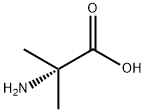
Product Name:
2-Aminoisobutyric Acid
Formula:
C4H9NO2
Synonyms:
α-Aminoisobutyric acid;2-Methylalanine;Aib
Inquiry
CHEMICAL AND PHYSICAL PROPERTIES
| Physical Description | Solid; [Merck Index] White solid; [Sigma-Aldrich MSDS] |
|---|---|
| Melting Point | 335 °C |
| Solubility | 181 mg/mL at 25 °C |
| Collision Cross Section | 123.8 Ų [M+H]+ [CCS Type: DT, Method: single field calibrated with ESI Low Concentration Tuning Mix (Agilent)] |
| Chemical Classes | Nitrogen Compounds -> Amino Carboxylic Acids |
SAFETY INFORMATION
| Signal word | Warning |
|---|---|
| Pictogram(s) |
 Exclamation Mark Irritant GHS07 |
| GHS Hazard Statements |
H319:Serious eye damage/eye irritation |
| Precautionary Statement Codes |
P264:Wash hands thoroughly after handling. P264:Wash skin thouroughly after handling. P280:Wear protective gloves/protective clothing/eye protection/face protection. P305+P351+P338:IF IN EYES: Rinse cautiously with water for several minutes. Remove contact lenses, if present and easy to do. Continuerinsing. P337+P313:IF eye irritation persists: Get medical advice/attention. |
COMPUTED DESCRIPTORS
| Molecular Weight | 103.12 g/mol |
|---|---|
| XLogP3 | -2.8 |
| Hydrogen Bond Donor Count | 2 |
| Hydrogen Bond Acceptor Count | 3 |
| Rotatable Bond Count | 1 |
| Exact Mass | 103.063328530 g/mol |
| Monoisotopic Mass | 103.063328530 g/mol |
| Topological Polar Surface Area | 63.3 Ų |
| Heavy Atom Count | 7 |
| Formal Charge | 0 |
| Complexity | 87.7 |
| Isotope Atom Count | 0 |
| Defined Atom Stereocenter Count | 0 |
| Undefined Atom Stereocenter Count | 0 |
| Defined Bond Stereocenter Count | 0 |
| Undefined Bond Stereocenter Count | 0 |
| Covalently-Bonded Unit Count | 1 |
| Compound Is Canonicalized | Yes |
PRODUCT INTRODUCTION
description
2-aminoisobutyric acid is a rare, non-protein amino acid and end-product of pyrimidine metabolism, excreted in urine and found in some antibiotics of fungal origin. With the exception of a few bacteria, it is non-metabolisable, and therefore used in bioassays. It is functionally related to a propionic acid and an isobutyric acid.