
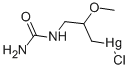
CHEMICAL AND PHYSICAL PROPERTIES
| Physical Description | Solid |
|---|---|
| Melting Point | 152.5 °C |
| Solubility | 11000 mg/L (at 25 °C) |
| LogP | -0.8 |
COMPUTED DESCRIPTORS
| Molecular Weight | 367.20 g/mol |
|---|---|
| Hydrogen Bond Donor Count | 2 |
| Hydrogen Bond Acceptor Count | 2 |
| Rotatable Bond Count | 4 |
| Exact Mass | 368.021549 g/mol |
| Monoisotopic Mass | 368.021549 g/mol |
| Topological Polar Surface Area | 64.4 Ų |
| Heavy Atom Count | 11 |
| Formal Charge | 0 |
| Complexity | 125 |
| Isotope Atom Count | 0 |
| Defined Atom Stereocenter Count | 0 |
| Undefined Atom Stereocenter Count | 1 |
| Defined Bond Stereocenter Count | 0 |
| Undefined Bond Stereocenter Count | 0 |
| Covalently-Bonded Unit Count | 1 |
| Compound Is Canonicalized | Yes |
PRODUCT INTRODUCTION
description
Chlormerodrin is urea in which one of the hydrogens is substituted by a 3-chloromercury-2-methoxyprop-1-yl group. It was formerly used as a diuretic, but more potent and less toxic drugs are now available. Its radiolabelled ((197)Hg, (203)Hg) forms were used in diagnostic aids in renal imaging and brain scans. It has a role as a diuretic and a diagnostic agent. It is an organomercury compound and a member of ureas.