
58-89-9
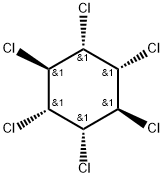
Product Name:
Lindane
Formula:
C6H6Cl6
Synonyms:
Lindane;γ-BHC;gamma-hexachlorocyclohexane;1α,2α,3β,4α,5α,6β-Hexachlorocyclohexane;γ-1,2,3,4,5,6-Hexachlorocyclohexane
Inquiry
SAFETY INFORMATION
| Signal word | Danger |
|---|---|
| Pictogram(s) |
 Skull and Crossbones Acute Toxicity GHS06  Health Hazard GHS08  Environment GHS09 |
| GHS Hazard Statements |
H301:Acute toxicity,oral H362:Reproductive toxicity, effects on or via lactation H373:Specific target organ toxicity, repeated exposure H410:Hazardous to the aquatic environment, long-term hazard |
| Precautionary Statement Codes |
P260:Do not breathe dust/fume/gas/mist/vapours/spray. P263:Avoid contact during pregnancy/while nursing. P273:Avoid release to the environment. P280:Wear protective gloves/protective clothing/eye protection/face protection. P301+P310:IF SWALLOWED: Immediately call a POISON CENTER or doctor/physician. |
PRODUCT INTRODUCTION
Description
Benzene hexachloride is also known as Lindane or hexachlorane, a colourless solid with a slight musty odour. It is an organochlorine chemical and is widely used as an agricultural insecticide as well as a pharmaceutical treatment for scabies and lice. Some side effects of lindane are burning, stinging, or redness of the skin. In the year 1825, Faraday was the first person to originally synthesize this chemical. In the year 1942, a Dutch chemist Teunis van der Linden isolated Benzene hexachloride. He was the first one to describe γ-hexachlorocyclohexane in the year 1912. Its pesticidal action was discovered in 1942.