
CHEMICAL AND PHYSICAL PROPERTIES
| Physical Description | Solid |
|---|
COMPUTED DESCRIPTORS
| Molecular Weight | 254.26 g/mol |
|---|---|
| XLogP3 | -4.9 |
| Hydrogen Bond Donor Count | 4 |
| Hydrogen Bond Acceptor Count | 7 |
| Rotatable Bond Count | 7 |
| Exact Mass | 254.05725734 g/mol |
| Monoisotopic Mass | 254.05725734 g/mol |
| Topological Polar Surface Area | 155 Ų |
| Heavy Atom Count | 16 |
| Formal Charge | 0 |
| Complexity | 346 |
| Isotope Atom Count | 0 |
| Defined Atom Stereocenter Count | 1 |
| Undefined Atom Stereocenter Count | 0 |
| Defined Bond Stereocenter Count | 0 |
| Undefined Bond Stereocenter Count | 0 |
| Covalently-Bonded Unit Count | 1 |
| Compound Is Canonicalized | Yes |
PRODUCT INTRODUCTION
description
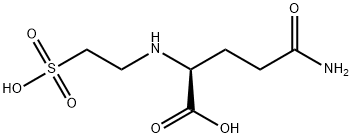
Glutaurine is a dipeptide resulting from the formal condensation of the amino group of taurine with the gamma-carboxy group of L-glutamic acid. It was initially found in the parathyroid in 1980 and later in the brain of mammals. It has a role as a mouse metabolite, a mammalian metabolite, a human metabolite, an anticonvulsant, an anxiolytic drug and a hormone. It is a L-glutamine derivative, a sulfonic acid and a dipeptide. It is functionally related to a taurine. It is a tautomer of a glutaurine zwitterion.