
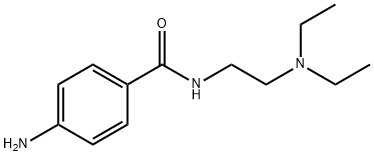
CHEMICAL AND PHYSICAL PROPERTIES
| Physical Description | Solid |
|---|---|
| Melting Point | 165-169 °C |
| Solubility | 5050 mg/L |
| LogP | 0.88 |
| Dissociation Constants | 9.24 |
| Kovats Retention Index | 2193 2193 2250 2199.8 2240 2245 2248 |
| Other Experimental Properties | FREELY SOL IN WATER; SOL IN ALCOHOL; SLIGHTLY SOL IN CHLOROFORM; VERY SPARINGLY SOL IN BENZENE, ETHER; MP: 165-169 °C; MAX ABSORPTION: 278 NM; PH OF 10% AQ SOLN: 5.5 /HYDROCHLORIDE SALT/ |
COMPUTED DESCRIPTORS
| Molecular Weight | 235.33 g/mol |
|---|---|
| XLogP3 | 0.9 |
| Hydrogen Bond Donor Count | 2 |
| Hydrogen Bond Acceptor Count | 3 |
| Rotatable Bond Count | 6 |
| Exact Mass | 235.168462302 g/mol |
| Monoisotopic Mass | 235.168462302 g/mol |
| Topological Polar Surface Area | 58.4 Ų |
| Heavy Atom Count | 17 |
| Formal Charge | 0 |
| Complexity | 221 |
| Isotope Atom Count | 0 |
| Defined Atom Stereocenter Count | 0 |
| Undefined Atom Stereocenter Count | 0 |
| Defined Bond Stereocenter Count | 0 |
| Undefined Bond Stereocenter Count | 0 |
| Covalently-Bonded Unit Count | 1 |
| Compound Is Canonicalized | Yes |
PRODUCT INTRODUCTION
description
Procainamide is a benzamide that is 4-aminobenzamide substituted on the amide N by a 2-(diethylamino)ethyl group. It is a pharmaceutical antiarrhythmic agent used for the medical treatment of cardiac arrhythmias. It has a role as a sodium channel blocker, an anti-arrhythmia drug and a platelet aggregation inhibitor.