
CHEMICAL AND PHYSICAL PROPERTIES
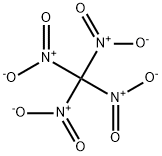
| Physical Description | Tetranitromethane appears as a pale yellow liquid. Irritates skin and respiratory tract. Very toxic by inhalation. Difficult to ignite. Burns at a steady rate once ignited. Under prolonged exposure to fire or heat containers may rupture violently and rocket Produces toxic oxides of nitrogen during combustion. |
|---|---|
| Color/Form | Colorless oily fluid |
| Odor | Distinct pungent odor |
| Boiling Point | 259 °F at 760 mmHg (EPA, 1998) |
| Melting Point | 57.6 °F (EPA, 1998) |
| Flash Point | greater than 235 °F (NTP, 1992) |
| Solubility | less than 1 mg/mL at 68 °F (NTP, 1992) |
| Density | 1.638 at 68 °F (EPA, 1998) - Denser than water; will sink |
| Vapor Density | 6.8 (EPA, 1998) - Heavier than air; will sink (Relative to Air) |
| Vapor Pressure | 13 mmHg at 77 °F (EPA, 1998) |
| Decomposition | It should not be distilled, as explosive decomposition may occur. |
| Viscosity | 1.76 cP at 20 °C |
| Corrosivity | Attacks iron, copper, brass, zinc, rubber |
| Refractive Index | Index of refraction = 1.4384 at 20 °C/D |
| Other Experimental Properties | Powerful oxidizing agent |
| Chemical Classes | Toxic Gases & Vapors -> Oxidizers |
COMPUTED DESCRIPTORS
| Molecular Weight | 196.03 g/mol |
|---|---|
| XLogP3 | 0.1 |
| Hydrogen Bond Donor Count | 0 |
| Hydrogen Bond Acceptor Count | 8 |
| Rotatable Bond Count | 0 |
| Exact Mass | 195.97161297 g/mol |
| Monoisotopic Mass | 195.97161297 g/mol |
| Topological Polar Surface Area | 183 Ų |
| Heavy Atom Count | 13 |
| Formal Charge | 0 |
| Complexity | 209 |
| Isotope Atom Count | 0 |
| Defined Atom Stereocenter Count | 0 |
| Undefined Atom Stereocenter Count | 0 |
| Defined Bond Stereocenter Count | 0 |
| Undefined Bond Stereocenter Count | 0 |
| Covalently-Bonded Unit Count | 1 |
| Compound Is Canonicalized | Yes |
PRODUCT INTRODUCTION
description
Tetranitromethane appears as a pale yellow liquid. Irritates skin and respiratory tract. Very toxic by inhalation. Difficult to ignite. Burns at a steady rate once ignited. Under prolonged exposure to fire or heat containers may rupture violently and rocket Produces toxic oxides of nitrogen during combustion.