
CHEMICAL AND PHYSICAL PROPERTIES
| Physical Description | Solid |
|---|---|
| Solubility | 1.27e-02 g/L |
COMPUTED DESCRIPTORS
| Molecular Weight | 475.7 g/mol |
|---|---|
| XLogP3 | 3.5 |
| Hydrogen Bond Donor Count | 1 |
| Hydrogen Bond Acceptor Count | 7 |
| Rotatable Bond Count | 8 |
| Exact Mass | 475.19633427 g/mol |
| Monoisotopic Mass | 475.19633427 g/mol |
| Topological Polar Surface Area | 97.8 Ų |
| Heavy Atom Count | 32 |
| Formal Charge | 0 |
| Complexity | 691 |
| Isotope Atom Count | 0 |
| Defined Atom Stereocenter Count | 0 |
| Undefined Atom Stereocenter Count | 0 |
| Defined Bond Stereocenter Count | 0 |
| Undefined Bond Stereocenter Count | 0 |
| Covalently-Bonded Unit Count | 1 |
| Compound Is Canonicalized | Yes |
PRODUCT INTRODUCTION
description
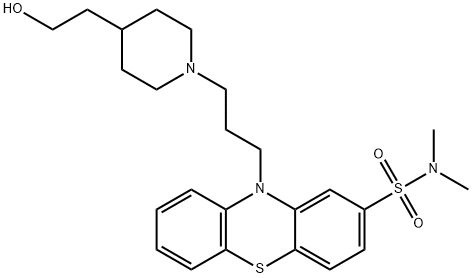
Pipotiazine has actions similar to those of other phenothiazines. Among the different phenothiazine derivatives, it appears to be less sedating and to have a weak propensity for causing hypotension or potentiating the effects of CNS depressants and anesthetics. However, it produces a high incidence of extra pyramidal reactions. It is used for the maintenance treatment of chronic non-agitated schizophrenic patients. Symptoms of overdose include severe extrapyramidal manifestations, hypotension, lethargy and sedation.