
CHEMICAL AND PHYSICAL PROPERTIES
| Solubility | Soluble in water. |
|---|
COMPUTED DESCRIPTORS
| Molecular Weight | 1047.2 g/mol |
|---|---|
| XLogP3 | 4.7 |
| Hydrogen Bond Donor Count | 9 |
| Hydrogen Bond Acceptor Count | 11 |
| Rotatable Bond Count | 18 |
| Exact Mass | 1046.50142372 g/mol |
| Monoisotopic Mass | 1046.50142372 g/mol |
| Topological Polar Surface Area | 281 Ų |
| Heavy Atom Count | 77 |
| Formal Charge | 0 |
| Complexity | 1940 |
| Isotope Atom Count | 0 |
| Defined Atom Stereocenter Count | 7 |
| Undefined Atom Stereocenter Count | 0 |
| Defined Bond Stereocenter Count | 0 |
| Undefined Bond Stereocenter Count | 0 |
| Covalently-Bonded Unit Count | 1 |
| Compound Is Canonicalized | Yes |
PRODUCT INTRODUCTION
description
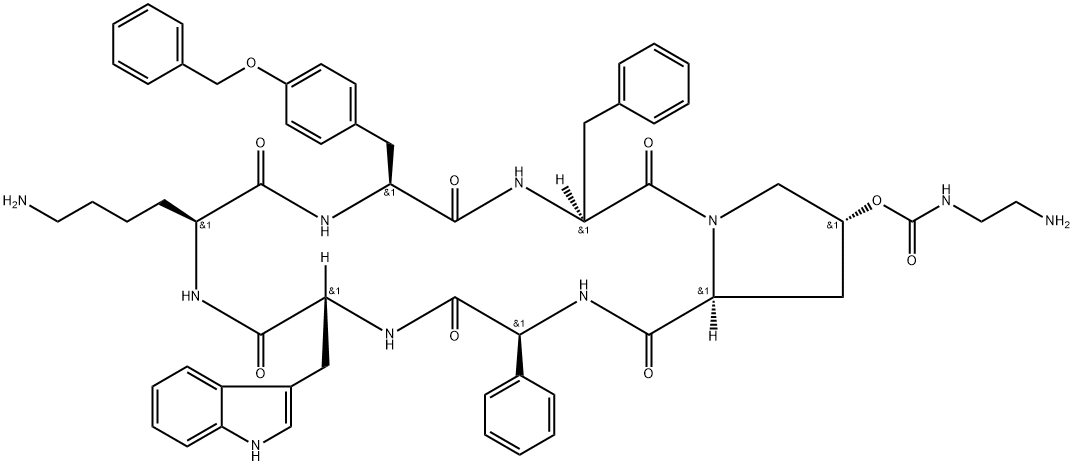
Pasireotide is a six-membered homodetic cyclic peptide composed from L-phenylglycyl, D-tryptophyl, L-lysyl, O-benzyl-L-tyrosyl, L-phenylalanyl and modified L-hydroxyproline residues joined in sequence. A somatostatin analogue with pharmacologic properties mimicking those of the natural hormone somatostatin; used (as its diaspartate salt) for treatment of Cushing's disease. It has a role as an antineoplastic agent. It is a homodetic cyclic peptide and a peptide hormone. It is a conjugate base of a pasireotide(2+).