
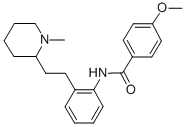
CHEMICAL AND PHYSICAL PROPERTIES
| Physical Description | Solid |
|---|---|
| Solubility | 4.01e-03 g/L |
| LogP | 4 |
COMPUTED DESCRIPTORS
| Molecular Weight | 352.5 g/mol |
|---|---|
| XLogP3 | 4.3 |
| Hydrogen Bond Donor Count | 1 |
| Hydrogen Bond Acceptor Count | 3 |
| Rotatable Bond Count | 6 |
| Exact Mass | 352.215078140 g/mol |
| Monoisotopic Mass | 352.215078140 g/mol |
| Topological Polar Surface Area | 41.6 Ų |
| Heavy Atom Count | 26 |
| Formal Charge | 0 |
| Complexity | 434 |
| Isotope Atom Count | 0 |
| Defined Atom Stereocenter Count | 0 |
| Undefined Atom Stereocenter Count | 1 |
| Defined Bond Stereocenter Count | 0 |
| Undefined Bond Stereocenter Count | 0 |
| Covalently-Bonded Unit Count | 1 |
| Compound Is Canonicalized | Yes |
PRODUCT INTRODUCTION
description
Encainide is 4-Methoxy-N-phenylbenzamide in which the hydrogen at the 2 position of the phenyl group is substituted by a 2-(1-methylpiperidin-2-yl)ethyl group. A class Ic antiarrhythmic, the hydrochloride was used for the treatment of severe or life-threatening ventricular arrhythmias, but it was associated with increased death rates in patients who had asymptomatic heart rhythm abnormalities after a recent heart attack and was withdrawn from the market. It has a role as an anti-arrhythmia drug and a sodium channel blocker. It is a member of piperidines and a member of benzamides.