
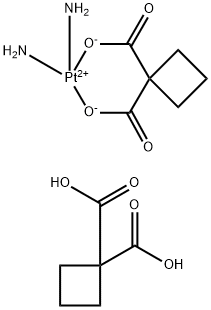
COMPUTED DESCRIPTORS
| Molecular Weight | 515.38 g/mol |
|---|---|
| Hydrogen Bond Donor Count | 4 |
| Hydrogen Bond Acceptor Count | 10 |
| Rotatable Bond Count | 2 |
| Exact Mass | 515.086760 g/mol |
| Monoisotopic Mass | 515.086760 g/mol |
| Topological Polar Surface Area | 157 Ų |
| Heavy Atom Count | 23 |
| Formal Charge | 0 |
| Complexity | 317 |
| Isotope Atom Count | 0 |
| Defined Atom Stereocenter Count | 0 |
| Undefined Atom Stereocenter Count | 0 |
| Defined Bond Stereocenter Count | 0 |
| Undefined Bond Stereocenter Count | 0 |
| Covalently-Bonded Unit Count | 5 |
| Compound Is Canonicalized | Yes |
PRODUCT INTRODUCTION
description
Dicycloplatin is a third-generation, supramolecular platinum-based compound composed of carboplatin linked, by a strong hydrogen bond, to 1,1-cyclobutane dicarboxylate (CBDCA), with potential antineoplastic activity. Although the exact mechanism of action has yet to be fully elucidated, dicycloplatin appears to have a mechanism of action similar to that of other platinum-based compounds, which involves both DNA binding and the formation of DNA crosslinks. This mechanism results in the induction of apoptosis and cell growth inhibition. Compared to carboplatin alone, dicycloplatin shows enhanced solubility and stability in aqueous solution and appears to have a more favorable toxicity profile.