
CHEMICAL AND PHYSICAL PROPERTIES
| Physical Description | Solid |
|---|---|
| Melting Point | 195-202°C with decomposition |
| Solubility | 7.98e-03 g/L |
COMPUTED DESCRIPTORS
| Molecular Weight | 392.5 g/mol |
|---|---|
| XLogP3 | 3.3 |
| Hydrogen Bond Donor Count | 4 |
| Hydrogen Bond Acceptor Count | 4 |
| Rotatable Bond Count | 6 |
| Exact Mass | 392.20999276 g/mol |
| Monoisotopic Mass | 392.20999276 g/mol |
| Topological Polar Surface Area | 81.6 Ų |
| Heavy Atom Count | 29 |
| Formal Charge | 0 |
| Complexity | 589 |
| Isotope Atom Count | 0 |
| Defined Atom Stereocenter Count | 1 |
| Undefined Atom Stereocenter Count | 0 |
| Defined Bond Stereocenter Count | 0 |
| Undefined Bond Stereocenter Count | 0 |
| Covalently-Bonded Unit Count | 1 |
| Compound Is Canonicalized | Yes |
PRODUCT INTRODUCTION
description
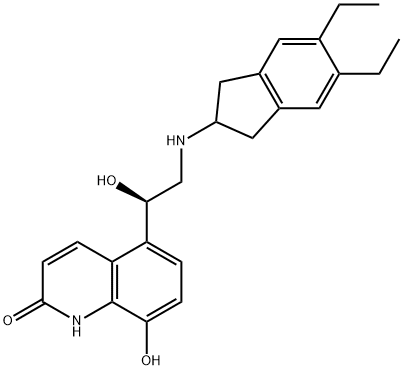
Indacaterol is a monohydroxyquinoline that consists of 5-[(1R)-2-amino-1-hydroxyethyl]-8-hydroxyquinolin-2-one having a 5,6-diethylindan-2-yl group attached to the amino function. Used as the maleate salt for treatment of chronic obstructive pulmonary disease. It has a role as a beta-adrenergic agonist and a bronchodilator agent. It is a quinolone, a monohydroxyquinoline, a member of indanes, a secondary alcohol and a secondary amino compound. It is a conjugate base of an indacaterol(1+).