
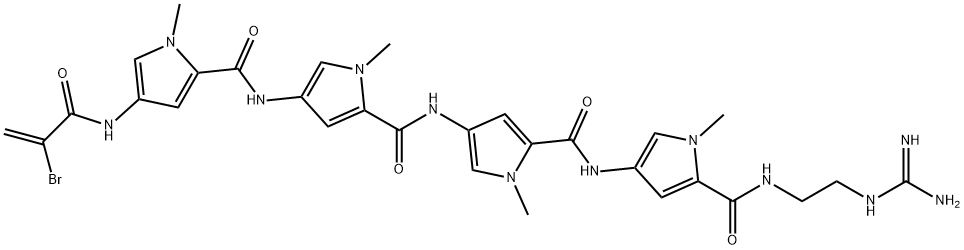
COMPUTED DESCRIPTORS
| Molecular Weight | 723.6 g/mol |
|---|---|
| XLogP3 | -0.9 |
| Hydrogen Bond Donor Count | 7 |
| Hydrogen Bond Acceptor Count | 6 |
| Rotatable Bond Count | 12 |
| Exact Mass | 722.20367 g/mol |
| Monoisotopic Mass | 722.20367 g/mol |
| Topological Polar Surface Area | 230 Ų |
| Heavy Atom Count | 48 |
| Formal Charge | 0 |
| Complexity | 1280 |
| Isotope Atom Count | 0 |
| Defined Atom Stereocenter Count | 0 |
| Undefined Atom Stereocenter Count | 0 |
| Defined Bond Stereocenter Count | 0 |
| Undefined Bond Stereocenter Count | 0 |
| Covalently-Bonded Unit Count | 1 |
| Compound Is Canonicalized | Yes |
PRODUCT INTRODUCTION
description
Brostallicin is a synthetic, alpha-bromoacrylic, second-generation minor groove binder (MGB), related to distamycin A, with potential antineoplastic activity. Brostallicin binds to DNA minor groove DNA, after having formed a highly reactive glutathione (GSH)-brostallicin complex in the presence of the enzyme glutathione S-transferase (GST), which is overexpressed in cancer cells; DNA replication and cell division are inhibited, resulting in tumor cell death. Compared to typical MGBs, this agent appears to bind covalently to DNA in a different manner and its activity does not depend on a functional DNA mismatch repair (MMR) mechanism. Accordingly, brostallicin may be effective against MMR-defective tumors that are refractory to various anticancer agents.