
16409-43-1
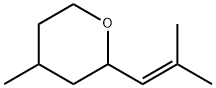
Product Name:
4-Methyl-2-(2-methyl-1-propenyl)tetrahydropyran (cis- and trans- mixture)
Formula:
C10H18O
Synonyms:
(+)-Rose oxide;(4R)-2-(2-Methyl-1-propenyl)-4-methyltetrahydropyran;(4S)-2-(2-Methyl-1-propenyl)-4-methyltetrahydropyran
Inquiry
CHEMICAL AND PHYSICAL PROPERTIES
| Physical Description | Liquid |
|---|---|
| Boiling Point | 86.00 °C. @ 20.00 mm Hg |
| Solubility | 764 mg/L @ 20 °C (exp) |
| Density | 0.873-0.877 |
| Refractive Index | 1.453-1.457 |
| Kovats Retention Index | 1096 1097 1097 1097 1097 1097 1097 1097 1097 1098 1093 1098 1092 1092 1096 1097 1099 1115 1100 |
SAFETY INFORMATION
| Signal word | Warning |
|---|---|
| Pictogram(s) |
 Exclamation Mark Irritant GHS07 |
| GHS Hazard Statements |
H315:Skin corrosion/irritation |
| Precautionary Statement Codes |
P264:Wash hands thoroughly after handling. P264:Wash skin thouroughly after handling. P280:Wear protective gloves/protective clothing/eye protection/face protection. P302+P352:IF ON SKIN: wash with plenty of soap and water. P332+P313:IF SKIN irritation occurs: Get medical advice/attention. |
COMPUTED DESCRIPTORS
| Molecular Weight | 154.25 g/mol |
|---|---|
| XLogP3 | 2.9 |
| Hydrogen Bond Donor Count | 0 |
| Hydrogen Bond Acceptor Count | 1 |
| Rotatable Bond Count | 1 |
| Exact Mass | 154.135765193 g/mol |
| Monoisotopic Mass | 154.135765193 g/mol |
| Topological Polar Surface Area | 9.2 Ų |
| Heavy Atom Count | 11 |
| Formal Charge | 0 |
| Complexity | 145 |
| Isotope Atom Count | 0 |
| Defined Atom Stereocenter Count | 0 |
| Undefined Atom Stereocenter Count | 2 |
| Defined Bond Stereocenter Count | 0 |
| Undefined Bond Stereocenter Count | 0 |
| Covalently-Bonded Unit Count | 1 |
| Compound Is Canonicalized | Yes |
PRODUCT INTRODUCTION
description
Rose oxide is a member of the class of oxanes that is tetrahydro-2H-pyran which is substituted at positions 2 and 4 by an isoprop-1-enyl group and a methyl group, respectively. Organic compound of the pyran class and the monoterpene class and a fragrance found in roses and rose oil. All four possible stereoisomers are known; the 2S,4R and 2S,4S diastereoisomers [also known as the (-)-cis- and (-)-trans-isomers, respectively] are the main constituents in several essential oils and are used as a food flavouring and in perfumes and cosmetics. It has a role as a plant metabolite. It is a monoterpenoid, a member of oxanes and an olefinic compound.