
SAFETY INFORMATION
| Signal word | Danger |
|---|---|
| Pictogram(s) |
 Skull and Crossbones Acute Toxicity GHS06  Environment GHS09 |
| GHS Hazard Statements |
H410:Hazardous to the aquatic environment, long-term hazard |
| Precautionary Statement Codes |
P260:Do not breathe dust/fume/gas/mist/vapours/spray. P264:Wash hands thoroughly after handling. P264:Wash skin thouroughly after handling. P270:Do not eat, drink or smoke when using this product. P271:Use only outdoors or in a well-ventilated area. P273:Avoid release to the environment. |
COMPUTED DESCRIPTORS
| Molecular Weight | 370.9 g/mol |
|---|---|
| Hydrogen Bond Donor Count | 1 |
| Hydrogen Bond Acceptor Count | 3 |
| Rotatable Bond Count | 0 |
| Exact Mass | 370.1448057 g/mol |
| Monoisotopic Mass | 370.1448057 g/mol |
| Topological Polar Surface Area | 32.8 Ų |
| Heavy Atom Count | 26 |
| Formal Charge | 0 |
| Complexity | 689 |
| Isotope Atom Count | 0 |
| Defined Atom Stereocenter Count | 6 |
| Undefined Atom Stereocenter Count | 0 |
| Defined Bond Stereocenter Count | 0 |
| Undefined Bond Stereocenter Count | 0 |
| Covalently-Bonded Unit Count | 2 |
| Compound Is Canonicalized | Yes |
PRODUCT INTRODUCTION
description
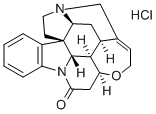
Strychnine hydrochloride is a hydrochloride obtained by combining strychnine with one molar equivalent of hydrogen chloride. It has a role as an avicide, a cholinergic antagonist, a glycine receptor antagonist, a rodenticide and a neurotransmitter agent. It is a hydrochloride and an organoammonium salt. It contains a strychnine(1+).