
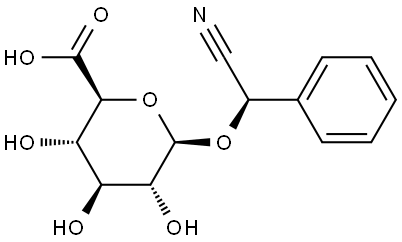
COMPUTED DESCRIPTORS
| Molecular Weight | 309.27 g/mol |
|---|---|
| XLogP3 | -0.3 |
| Hydrogen Bond Donor Count | 4 |
| Hydrogen Bond Acceptor Count | 8 |
| Rotatable Bond Count | 4 |
| Exact Mass | 309.08485182 g/mol |
| Monoisotopic Mass | 309.08485182 g/mol |
| Topological Polar Surface Area | 140 Ų |
| Heavy Atom Count | 22 |
| Formal Charge | 0 |
| Complexity | 442 |
| Isotope Atom Count | 0 |
| Defined Atom Stereocenter Count | 0 |
| Undefined Atom Stereocenter Count | 6 |
| Defined Bond Stereocenter Count | 0 |
| Undefined Bond Stereocenter Count | 0 |
| Covalently-Bonded Unit Count | 1 |
| Compound Is Canonicalized | Yes |
PRODUCT INTRODUCTION
description
Laetrile is originally, the name laetrile was the contraction of laevo-mandelonitrile glucoside, a cyanogenic glycoside found naturally in some plants. Over the years the meaning of laetrile has changed. There are now preparations called Laetrile where amygdalin is the major constituent. Laetrile and amygdalin are often used interchangeably, but are different agents. Cyanide and benzaldehyde are metabolites of both laetrile and amygdalin. Both metabolites may possess antineoplastic properties. Laetrile has been used as an anticancer treatment in humans worldwide, but scientific evidence does not support its effectiveness. It is not approved for use in the United States. (NCI04)