
118-52-5
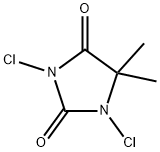
Product Name:
1,3-Dichloro-5,5-dimethylhydantoin
Formula:
C5H6Cl2N2O2
Synonyms:
1,3-Dichloro-5,5-dimethyl-2,4-imidazolidinedione;DCDMH;NSC 33307;NSC 38630
Inquiry
CHEMICAL AND PHYSICAL PROPERTIES
| Physical Description | 1,3-dichloro-5,5-dimethylhydantoin is a white powder with a weak chlorine odor. Conflagrates at 414 °F (turns brown). Chlorine gas evolves at temperatures > 410 °F. (NTP, 1992) |
|---|---|
| Color/Form | Four-sided, pointed prisms from chloroform |
| Odor | Chlorine-like odor |
| Boiling Point | Sublimes at 212 °F (NTP, 1992) |
| Melting Point | 270 °F (NTP, 1992) |
| Flash Point | 346 °F (NIOSH, 2023) |
| Solubility | Reaction (NTP, 1992) |
| Density | 1.5 at 68 °F (NTP, 1992) - Denser than water; will sink |
| Vapor Density | 6.8 (NTP, 1992) - Heavier than air; will sink (Relative to Air) |
| Vapor Pressure | 0.000024 [mmHg] |
| Stability/Shelf Life | The dry crystals [combined available chlorine 77.6% (theory)] may be stored without much loss of available chlorine. |
| Decomposition | When heated to decomposition it emits toxic vapors of /nitrogen oxide and hydrogen chloride/. |
| Corrosivity | PRESUMABLY LESS CORROSIVE THAN HYPOCHLORITE SOLUTIONS WITH SAME CONCN OF AVAILABLE CHLORINE |
| pH | pH of aqueous soln about 4.4 |
| Odor Threshold | Odor Threshold Low: 0.01 [mmHg] Odor threshold from "Quick Guide: The Electronic NIOSH Pocket Guide to Chemical Hazards" |
| Other Experimental Properties | Sublimes at 100 °C; turns brown and conflagrates at 212 °C (after melting at 132 °C); on contact with water and especially hot water hypochlorous acid is liberated, at pH 9 nitrogen chloride is formed |
| Chemical Classes | Nitrogen Compounds -> Other Nitrogen Compounds |
SAFETY INFORMATION
| Signal word | Danger |
|---|---|
| Pictogram(s) |
 Flame Over Circle Oxidizers GHS03  Exclamation Mark Irritant GHS07  Environment GHS09 |
| GHS Hazard Statements |
H272:Oxidising liquids;Oxidising solids H302:Acute toxicity,oral H315:Skin corrosion/irritation H317:Sensitisation, Skin H410:Hazardous to the aquatic environment, long-term hazard |
| Precautionary Statement Codes |
P210:Keep away from heat/sparks/open flames/hot surfaces. — No smoking. P220:Keep/Store away from clothing/…/combustible materials. P273:Avoid release to the environment. P280:Wear protective gloves/protective clothing/eye protection/face protection. P301+P312:IF SWALLOWED: call a POISON CENTER or doctor/physician IF you feel unwell. P302+P352:IF ON SKIN: wash with plenty of soap and water. |
COMPUTED DESCRIPTORS
| Molecular Weight | 197.02 g/mol |
|---|---|
| XLogP3 | 1.1 |
| Hydrogen Bond Donor Count | 0 |
| Hydrogen Bond Acceptor Count | 2 |
| Rotatable Bond Count | 0 |
| Exact Mass | 195.9806328 g/mol |
| Monoisotopic Mass | 195.9806328 g/mol |
| Topological Polar Surface Area | 40.6 Ų |
| Heavy Atom Count | 11 |
| Formal Charge | 0 |
| Complexity | 229 |
| Isotope Atom Count | 0 |
| Defined Atom Stereocenter Count | 0 |
| Undefined Atom Stereocenter Count | 0 |
| Defined Bond Stereocenter Count | 0 |
| Undefined Bond Stereocenter Count | 0 |
| Covalently-Bonded Unit Count | 1 |
| Compound Is Canonicalized | Yes |
PRODUCT INTRODUCTION
description
1,3-dichloro-5,5-dimethylhydantoin is a white powder with a weak chlorine odor. Conflagrates at 414 °F (turns brown). Chlorine gas evolves at temperatures > 410 °F. (NTP, 1992)