
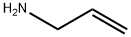
CHEMICAL AND PHYSICAL PROPERTIES
| Physical Description | Allylamine appears as a colorless to light yellow colored liquid with a strong ammonia-like odor. Less dense than water. Vapors are heavier than air. Toxic by inhalation, ingestion and skin absorption. Irritates skin, eyes and mucous membranes. Flash point below 0 °F. Boiling point 130 °F. Used to make pharmaceuticals and other chemicals. |
|---|---|
| Color/Form | Colorless to light yellow liquid |
| Odor | Strong ammonia odor causing sneezing and tears |
| Taste | Burning taste |
| Boiling Point | 131 to 136 °F at 760 mmHg (EPA, 1998) |
| Melting Point | -126 °F (NTP, 1992) |
| Flash Point | -20 °F (EPA, 1998) |
| Solubility | Very soluble (NTP, 1992) |
| Density | 0.76 at 68 °F (EPA, 1998) - Less dense than water; will float |
| Vapor Density | 2 (EPA, 1998) - Heavier than air; will sink (Relative to Air) |
| Vapor Pressure | 242.0 [mmHg] |
| LogP | log Kow = 0.03 |
| Stability/Shelf Life | Stable under recommended storage conditions. |
| Autoignition Temperature | 705 °F (NTP, 1992) |
| Decomposition | Hazardous decomposition products formed under fire conditions - Carbon oxides, nitrogen oxides (NOx). |
| Viscosity | 0.3745 Poise |
| Surface Tension | 3.9X10⁻² N/m at melting point |
| Polymerization | Polymerization may be caused by elevated temperature, oxidizers, peroxides. |
| Odor Threshold | Odor Threshold Low: 2.5 [mmHg] |
| Refractive Index | Index of refraction: 1.4205 at 20 °C/D |
| Dissociation Constants | pKa = 9.7 |
| Kovats Retention Index | 463 468 463 463 |
| Other Experimental Properties | 0.509 mm sq/s (static) at 20 °C |
| Chemical Classes | Toxic Gases & Vapors -> Other Toxic Gases & Vapors |
SAFETY INFORMATION
| Signal word | Danger |
|---|---|
| Pictogram(s) |
 Flame Flammables GHS02  Skull and Crossbones Acute Toxicity GHS06  Environment GHS09 |
| GHS Hazard Statements |
H225:Flammable liquids H301:Acute toxicity,oral H311:Acute toxicity,dermal H331:Acute toxicity,inhalation H411:Hazardous to the aquatic environment, long-term hazard |
| Precautionary Statement Codes |
P210:Keep away from heat/sparks/open flames/hot surfaces. — No smoking. P261:Avoid breathing dust/fume/gas/mist/vapours/spray. P303+P361+P353:IF ON SKIN (or hair): Remove/Take off Immediately all contaminated clothing. Rinse SKIN with water/shower. P405:Store locked up. |
COMPUTED DESCRIPTORS
| Molecular Weight | 57.09 g/mol |
|---|---|
| XLogP3 | 0.1 |
| Hydrogen Bond Donor Count | 1 |
| Hydrogen Bond Acceptor Count | 1 |
| Rotatable Bond Count | 1 |
| Exact Mass | 57.057849228 g/mol |
| Monoisotopic Mass | 57.057849228 g/mol |
| Topological Polar Surface Area | 26 Ų |
| Heavy Atom Count | 4 |
| Formal Charge | 0 |
| Complexity | 17.2 |
| Isotope Atom Count | 0 |
| Defined Atom Stereocenter Count | 0 |
| Undefined Atom Stereocenter Count | 0 |
| Defined Bond Stereocenter Count | 0 |
| Undefined Bond Stereocenter Count | 0 |
| Covalently-Bonded Unit Count | 1 |
| Compound Is Canonicalized | Yes |
PRODUCT INTRODUCTION
description
Allylamine appears as a colorless to light yellow colored liquid with a strong ammonia-like odor. Less dense than water. Vapors are heavier than air. Toxic by inhalation, ingestion and skin absorption. Irritates skin, eyes and mucous membranes. Flash point below 0 °F. Boiling point 130 °F. Used to make pharmaceuticals and other chemicals.
RELATED SUPPLIERS
All suppliers(2)