
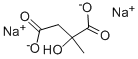
CHEMICAL AND PHYSICAL PROPERTIES
| Physical Description | Solid |
|---|---|
| Melting Point | 107 - 111 °C |
| Collision Cross Section | 124.87 Ų [M-H]- [CCS Type: DT, Method: stepped-field] |
COMPUTED DESCRIPTORS
| Molecular Weight | 148.11 g/mol |
|---|---|
| XLogP3 | -0.9 |
| Hydrogen Bond Donor Count | 3 |
| Hydrogen Bond Acceptor Count | 5 |
| Rotatable Bond Count | 3 |
| Exact Mass | 148.03717335 g/mol |
| Monoisotopic Mass | 148.03717335 g/mol |
| Topological Polar Surface Area | 94.8 Ų |
| Heavy Atom Count | 10 |
| Formal Charge | 0 |
| Complexity | 163 |
| Isotope Atom Count | 0 |
| Defined Atom Stereocenter Count | 0 |
| Undefined Atom Stereocenter Count | 1 |
| Defined Bond Stereocenter Count | 0 |
| Undefined Bond Stereocenter Count | 0 |
| Covalently-Bonded Unit Count | 1 |
| Compound Is Canonicalized | Yes |
PRODUCT INTRODUCTION
description
Citramalic acid is a 2-hydroxydicarboxylic acid that is malic acid (hydroxysuccinic acid) in which the hydrogen at position 2 is substituted by a methyl group. It has a role as a human metabolite, a plant metabolite and an algal metabolite. It is a 2-hydroxydicarboxylic acid, a 3-hydroxy carboxylic acid and a dicarboxylic fatty acid. It is functionally related to a succinic acid. It is a conjugate acid of a citramalate(2-).