
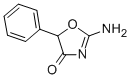
CHEMICAL AND PHYSICAL PROPERTIES
| Color/Form | Crystals |
|---|---|
| Taste | Tasteless |
| Melting Point | 256 dec °C |
| Solubility | Practically insol in ether, acetone, dil hydrochloric acid; sol in propylene glycol (1%) and hot alcohol |
| LogP | 0.7 |
| Decomposition | When heated to decomposition it emits toxic fumes of /Nitrogen oxide/. |
| Dissociation Constants | pKa = 10.5 |
| Kovats Retention Index | 2055 2080 |
COMPUTED DESCRIPTORS
| Molecular Weight | 176.17 g/mol |
|---|---|
| XLogP3 | 0.9 |
| Hydrogen Bond Donor Count | 1 |
| Hydrogen Bond Acceptor Count | 2 |
| Rotatable Bond Count | 1 |
| Exact Mass | 176.058577502 g/mol |
| Monoisotopic Mass | 176.058577502 g/mol |
| Topological Polar Surface Area | 64.7 Ų |
| Heavy Atom Count | 13 |
| Formal Charge | 0 |
| Complexity | 244 |
| Isotope Atom Count | 0 |
| Defined Atom Stereocenter Count | 0 |
| Undefined Atom Stereocenter Count | 1 |
| Defined Bond Stereocenter Count | 0 |
| Undefined Bond Stereocenter Count | 0 |
| Covalently-Bonded Unit Count | 1 |
| Compound Is Canonicalized | Yes |
PRODUCT INTRODUCTION
description
Pemoline is a member of the class of 1,3-oxazoles that is 1,3-oxazol-4(5H)-one which is substituted by an amino group at position 2 and by a phenyl group at position 5. A central nervous system stimulant, it was used to treat hyperactivity disorders in children, but withdrawn from use following reports of serious hepatotoxicity. It has a role as a central nervous system stimulant.