
13311-84-7
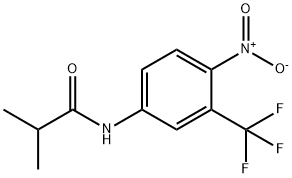
Product Name:
Flutamide
Formula:
C11H11F3N2O3
Synonyms:
2-Methyl-N-[4-nitro-3-(trifluoromethyl)phenyl]propanamide;Flutamide
Inquiry
CHEMICAL AND PHYSICAL PROPERTIES
| Physical Description | Solid |
|---|---|
| Melting Point | 111.5-112.5 |
| Solubility | >41.4 [ug/mL] (The mean of the results at pH 7.4) |
| LogP | 3.35 |
| Collision Cross Section | 160 Ų [M+H]+ [CCS Type: TW, Method: calibrated with polyalanine and drug standards] |
SAFETY INFORMATION
| Signal word | Warning |
|---|---|
| Pictogram(s) |
 Exclamation Mark Irritant GHS07  Health Hazard GHS08  Environment GHS09 |
| GHS Hazard Statements |
H302:Acute toxicity,oral H351:Carcinogenicity H361:Reproductive toxicity H373:Specific target organ toxicity, repeated exposure H411:Hazardous to the aquatic environment, long-term hazard |
| Precautionary Statement Codes |
P202:Do not handle until all safety precautions have been read and understood. P260:Do not breathe dust/fume/gas/mist/vapours/spray. P264:Wash hands thoroughly after handling. P264:Wash skin thouroughly after handling. P273:Avoid release to the environment. P301+P312:IF SWALLOWED: call a POISON CENTER or doctor/physician IF you feel unwell. P308+P313:IF exposed or concerned: Get medical advice/attention. |
COMPUTED DESCRIPTORS
| Molecular Weight | 276.21 g/mol |
|---|---|
| XLogP3 | 3.3 |
| Hydrogen Bond Donor Count | 1 |
| Hydrogen Bond Acceptor Count | 6 |
| Rotatable Bond Count | 2 |
| Exact Mass | 276.07217670 g/mol |
| Monoisotopic Mass | 276.07217670 g/mol |
| Topological Polar Surface Area | 74.9 Ų |
| Heavy Atom Count | 19 |
| Formal Charge | 0 |
| Complexity | 352 |
| Isotope Atom Count | 0 |
| Defined Atom Stereocenter Count | 0 |
| Undefined Atom Stereocenter Count | 0 |
| Defined Bond Stereocenter Count | 0 |
| Undefined Bond Stereocenter Count | 0 |
| Covalently-Bonded Unit Count | 1 |
| Compound Is Canonicalized | Yes |
PRODUCT INTRODUCTION
description
Flutamide is a monocarboxylic acid amide, it is used in the management and treatment of androgen-dependent tumors like prostate cancer and conditions associated with hyperandrogenism like polycystic ovarian syndrome (PCOS).