
(Z)-N'-(2-hydroxy-3-(piperidin-1-yl)propoxy)nicotiniMidaMide
- CAS NO.:66611-37-8
- Empirical Formula: C14H22N4O2
- Molecular Weight: 278.35008
- MDL number: MFCD21603901
- SAFETY DATA SHEET (SDS)
- Update Date: 2026-07-27 17:00:41
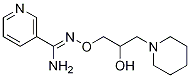
What is (Z)-N'-(2-hydroxy-3-(piperidin-1-yl)propoxy)nicotiniMidaMide?
Description
BGP-15 (66611-37-8) is a cellular protectant operating by several mechanisms. It is an insulin sensitizer1, HSP72 activator2, PARP inhibitor and ROS and lipid peroxidation reducer3. It protects mitochondria in acetaminophen-induced liver injury4 as well as LPS-induced destabilization5 and activates mitochondrial fusion6. Displays protective effects in heart failure7 and traumatic brain injury8 in animal models.
The Uses of (Z)-N'-(2-hydroxy-3-(piperidin-1-yl)propoxy)nicotiniMidaMide
BGP 15 is a calcipotriene-based vitamin D3 analog that inhibits poly(ADP-ribose) polymerasesis (PARP), a class of enzymes that regulate DNA repair and apoptosis (1). BGP 15 is also a cardioprotective agent (2). Also, BPG 15 improves mitochondrial function, protects neurons from dying in vitro and in vivo, and promotes cardiac innervation in vivo.
in vitro
previous study showed that bgp-15 at 200 μm could prevent the imatinib-induced oxidative damages, attenuate the depletion of high-energy phosphates, alter the signaling effect of imatinib by preventing p38 map kinase and jnk activation, and also induce the akt and gsk-3β phosphorylation [1].
in vivo
in-vivo study indicated that bgp-15 improved cardiac function and reduced arrhythmic episodes in two hf and af mouse models. in these models, bgp-15 was associated with increased phosphorylation of igf1r. moreover, cardiac-specific igf1r transgenic overexpression in mice recapitulated the protection caused by bgp-15. the authors further demonstrated that bgp-15 with igf1r could provide protection independent of phosphoinositide 3-kinase-akt and heat-shock protein 70 [2].
Storage
Store at -20°C
References
Peto et al. (2020), Pharmacological Overview of the BGP-15 Chemical Agent as a New Drug Candidate for the Treatment of Symptoms of Metabolic Syndrome; Molecules 25 429 Henstridge et al. (2014), Activating HSP72 in rodent skeletal muscle increases mitochondrial number and oxidative capacity and decreases insulin resistance; Diabetes 63 1881 Szabados et al. (2000), BGP-15, a nicotinic amidoxime derivative protecting heart from ischemia reperfusion injury through modulation of poly(ADP-ribose) polymerase; Biochem. Pharmacol. 59 937 Sarnyai et al. (2020), BGP-15 Protects Mitochondria in Acute Acetaminophen Overdose Induced Liver Injury; Pathol. Oncol. Res. 26 1797 Sumegi et al. (2017), BGP-15 Protects against Oxidative Stress- or Lipopolysaccharide-Induced Mitochondrial Destabilization and Reduces Mitochondrial Production of Reactive Oxygen Species; PLos One 12 e0169372 Szabo et al. (2018), Activation of mitochondrial fusion provides a new treatment for mitochondria-related diseases; Biochem. Pharmacol. 150 86 Sapra et al. (2014), The small-molecule BGP-15 protects against heart failure and atrial fibrillation in mice; Nat. Commun. 5 5705 Eroglu et al. (2014), Therapeutic inducers of the HSP70/HSP110 protect mice against traumatic brain injury; J. Neurochem. 130 626
Properties of (Z)-N'-(2-hydroxy-3-(piperidin-1-yl)propoxy)nicotiniMidaMide
| storage temp. | -20°C |
| solubility | Soluble in Water (70 mg/ml) |
| form | solid |
| color | Off-white |
| Stability: | Stable for 2 years from date of purchase as supplied. Solutions in water may be stored at room temperature for up to 1 month. |
Safety information for (Z)-N'-(2-hydroxy-3-(piperidin-1-yl)propoxy)nicotiniMidaMide
| Signal word | Danger |
| Pictogram(s) |
 Skull and Crossbones Acute Toxicity GHS06 |
| GHS Hazard Statements |
H301:Acute toxicity,oral |
| Precautionary Statement Codes |
P301+P310:IF SWALLOWED: Immediately call a POISON CENTER or doctor/physician. |
Computed Descriptors for (Z)-N'-(2-hydroxy-3-(piperidin-1-yl)propoxy)nicotiniMidaMide
New Products
2-Amino-5-bromo- benzoic acid Dibenzoyl-L-tartaric acid Anhydrous (Resolution Reagent) 1,2,3,9-Tetrahydro-9-Methyl-4H-Carbazole-4-One Cis-Tosylate Dibenzo[b,f][1,4]thiazepin-11(10H)-one BOC Piperazine N-Methyl-2-amino-2-methylpropionamide 4-(FMOC-AMINO)-TETRAHYDROPYRAN-4-CARBOXYLIC ACID 1-Aminocyclobutanecarboxylic Acid Hydrochloride 3-Oxocyclobutanecarboxylic acid AMINO(2-BROMOPHENYL)ACETIC ACID 6-BROMOTETRAZOLO[1,5-A]PYRIDINE 4-Amino-2-chloro-6,7-dimethoxyquinazoline 2,3-Dimethoxypyridine 2,6-bis(bromomethyl)pyridine tert-Butyl 4-mercaptopiperidine-1-carboxylate 4'-(Methylmercapto)-acetophrnonone 1-Benzhydrylazetidin-3-ol-Hcl 1-(3-Chlorophenyl)piperazine hydrochloride Enzyme Breaker for Coal Bed Methane Slickwaterr Gas Well Guar Gum Enzyme Breaker Enzyme Breaker for Conventional Slickwater Fracturing Conventional Fracturing Guar Gum Enzyme Breaker Coalbed Methane Guar Gum Enzyme BreakerRelated products of tetrahydrofuran
![N-[4-[[1-[2-(6-METHYL-2-PYRIDINYL)ETHYL]-4-PIPERIDINYL]CARBONYL]PHENYL]METHANESULFONAMIDE DIHYDROCHLORIDE](https://img.chemicalbook.in/CAS/GIF/113558-89-7.gif)
You may like
-
 BGP-15 >95% CAS 66611-37-8View Details
66611-37-8 -
BGP-15 CAS 66611-37-8View Details
66611-37-8 -
254762-66-8 AMINO(2-BROMOPHENYL)ACETIC ACID 98+View Details
254762-66-8 -
6-BROMOTETRAZOLO[1,5-A]PYRIDINE 98+View Details
5799-75-7 -
254762-66-8 AMINO(2-BROMOPHENYL)ACETIC ACID 98+View Details
254762-66-8 -
23716-23-1 98+View Details
23716-23-1 -
6-BROMOTETRAZOLO[1,5-A]PYRIDINE 98+View Details
5799-75-7 -
1778-09-2 4'-(Methylmercapto)-acetophrnonone 98%View Details
1778-09-2