
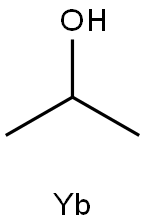
Yttrium(III) isopropoxide
Synonym(s):2-Propanol yttrium(III) salt;Isopropyl alcohol yttrium(III) salt;Tris(isopropoxy) yttrium(III)
- CAS NO.:2172-12-5
- Empirical Formula: C9H21O3Y
- Molecular Weight: 266.17
- MDL number: MFCD00015641
- SAFETY DATA SHEET (SDS)
- Update Date: 2026-09-12 18:48:21

What is Yttrium(III) isopropoxide?
The Uses of Yttrium(III) isopropoxide
Yttrium(III) isopropoxide is used in asymmetric catalysis applications. It acts as a catalyst for stereoselective conjugate addition reactions and ring-opening polymerizations. It serves as a precursor for the generation of reactive enolates by enantioselective protonation reactions and nanocomposites synthesis. Further, it is used in the preparation of flat hafnium(IV) oxide films. In addition to this, it is used to improve the thermal conductivity of polycrystalline aluminum nitride (AlN) ceramics.
The Uses of Yttrium(III) isopropoxide
Catalyst for:
- Stereoselective conjugate addition reactions
- Ring-opening polymerizations
- Generation of reactive enolates by enantioselective protonation reactions
- Cyano-phosphorylation of enone and allylic substitution
- Synthesis of nanocomposites
Reactant for the preparation of flat HfO2 films
What are the applications of Application
Yttrium(III) tris(isopropoxide) is a useful catalyst for research
Properties of Yttrium(III) isopropoxide
| Melting point: | 160°C |
| Boiling point: | 106 °C |
| Density | 0.955 g/mL at 25 °C |
| Flash point: | 38 °F |
| solubility | Soluble in hexane, toluene, and THF. |
| form | solid |
| color | White to Almost white |
| Sensitive | Moisture Sensitive |
| Hydrolytic Sensitivity | 8: reacts rapidly with moisture, water, protic solvents |
| Exposure limits | ACGIH: TWA 20 ppm OSHA: Ceiling 300 ppm; TWA 200 ppm NIOSH: IDLH 500 ppm; TWA 100 ppm(375 mg/m3); STEL 150 ppm(560 mg/m3) |
| CAS DataBase Reference | 2172-12-5(CAS DataBase Reference) |
Safety information for Yttrium(III) isopropoxide
| Signal word | Warning |
| Pictogram(s) |
 Flame Flammables GHS02  Exclamation Mark Irritant GHS07 |
| GHS Hazard Statements |
H228:Flammable solids H315:Skin corrosion/irritation H319:Serious eye damage/eye irritation H335:Specific target organ toxicity, single exposure;Respiratory tract irritation |
| Precautionary Statement Codes |
P210:Keep away from heat/sparks/open flames/hot surfaces. — No smoking. P302+P352:IF ON SKIN: wash with plenty of soap and water. P305+P351+P338:IF IN EYES: Rinse cautiously with water for several minutes. Remove contact lenses, if present and easy to do. Continuerinsing. |
Computed Descriptors for Yttrium(III) isopropoxide
New Products
9-Mesityl-10-methylacridinium perchlorate Sulfapyridine Fmoc-OSu (R)-(-)-2-Amino-1-propanol Cyclobutanone 5-bromo-4-fluoro-2-nitrobenzaldehyde 4 pentyn 1 ol N-Vinylformamide Phenethyl cinnamate Pyrrolo[1,2-a]pyrimidine-6-carboxylic acid, 4,6,7,8-tetrahydro-4-oxo-, sodium salt (1:1), (6S) Ethyl 3-phenylpropanoate β-Bromostyrene Methacrylate-PEG-Methacrylate, Mn:35000 2,4-Dihydroxyacetophenone 2-Chloro 5-Fluoro Pyridine Vasicinone 2-Chloroisonicotinic Acid Tween 80 or Polysorbate 80 5-Bromo-1-Pentyne 1-(2-Methyl-5-nitrophenyl)guanidine Nitrate Methyl trans-4-Aminocyclohexanecarboxylate Hydrochloride 2-Pentyn-1-oL 4-Nitrobenzotrifluoride N-(4-Cyano-3-(trifluoromethyl)phenyl)-2-methyloxirane-2-carboxamideRelated products of tetrahydrofuran


You may like
-
 Yttrium(III) isopropoxide CAS 2172-12-5View Details
2172-12-5 -
Yttrium(III) isopropoxide CAS 2172-12-5View Details
2172-12-5 -
Yttrium(III) isopropoxide CAS 2172-12-5View Details
2172-12-5 -
Yttrium(III) Isopropoxide CAS 2172-12-5View Details
2172-12-5 -
1191-95-3 Cyclobutanone 98+View Details
1191-95-3 -
213382-45-7 98+View Details
213382-45-7 -
Fmoc-OSu 98+View Details
82911-69-1 -
(R)-(-)-2-Amino-1-propanol 35320-23-1 98+View Details
35320-23-1
Statement: All products displayed on this website are only used for non medical purposes such as industrial applications or scientific research, and cannot be used for clinical diagnosis or treatment of humans or animals. They are not medicinal or edible.