
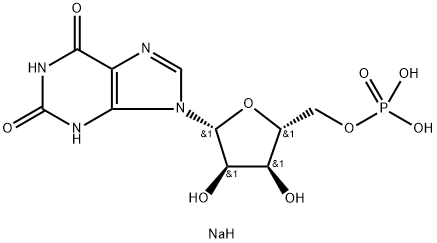
XANTHOSINE DIHYDRATE
Synonym(s):9-β-D -Ribofuranosylxanthine
- CAS NO.:5968-90-1
- Empirical Formula: C10H14N4O7
- Molecular Weight: 302.24
- MDL number: MFCD00149347
- EINECS: 205-679-9
- SAFETY DATA SHEET (SDS)
- Update Date: 2026-05-28 02:01:01
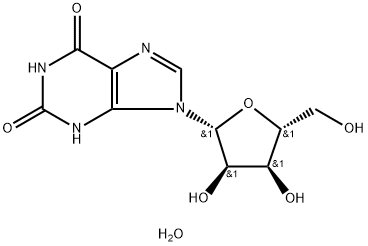
What is XANTHOSINE DIHYDRATE?
Chemical properties
white crystalline powder
The Uses of XANTHOSINE DIHYDRATE
The deamination product of Guanosine. Potential biomarker for detecting radiation exposure. Xanthosine Dihydrate can be used in the amplification of DNA isothermal strand displacement.
The Uses of XANTHOSINE DIHYDRATE
The deamination product of Guanosine. Potential biomarker for detecting radiation exposure. Used in the amplification of DNA isothermal strand displacement.
The Uses of XANTHOSINE DIHYDRATE
Xanthosine dihydrate has been used as a test compound in one dimensional liquid chromatography analysis (1D-LC ).
What are the applications of Application
Xanthosine dihydrate is a useful biochemical for proteomics research
General Description
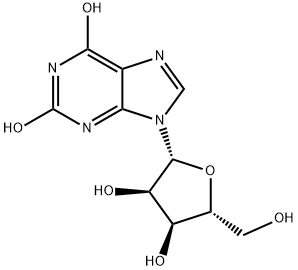
Xanthosine comprises xanthine ring. It is derived from a purine metabolite and is a caffeine biosynthesis intermediate.
Biochem/physiol Actions
Xanthosine plays a key role in purine metabolism. High levels of xanthosine excretion is observed in breast cancer.
Purification Methods
It crystallises from EtOH (anhydrous) or water (as dihydrate). [Howard et al. J Chem Soc 232 1949, Beilstein 31 H 28, 26 III/IV 2428.]
Properties of XANTHOSINE DIHYDRATE
| Melting point: | >215°C (dec.) |
| storage temp. | Store at RT. |
| solubility | Aqueous Base (Slightly), DMSO (Slightly), Methanol (Slightly) |
| form | Solid |
| color | White to Off-White |
| Stability: | Hygroscopic |
Safety information for XANTHOSINE DIHYDRATE
| Signal word | Warning |
| Pictogram(s) |
 Exclamation Mark Irritant GHS07 |
| GHS Hazard Statements |
H302:Acute toxicity,oral H315:Skin corrosion/irritation H319:Serious eye damage/eye irritation H335:Specific target organ toxicity, single exposure;Respiratory tract irritation |
| Precautionary Statement Codes |
P261:Avoid breathing dust/fume/gas/mist/vapours/spray. P305+P351+P338:IF IN EYES: Rinse cautiously with water for several minutes. Remove contact lenses, if present and easy to do. Continuerinsing. |
Computed Descriptors for XANTHOSINE DIHYDRATE
New Products
5-bromo-4-fluoro-2-nitrobenzaldehyde (R)-(-)-2-Amino-1-propanol Cyclobutanone Fmoc-OSu 1-(2-Chloroethyl)pyrrolidine Hydrochloride 2-Amino-2-(4-methylphenyl)acetic acid Obidoxime hydrochloride API Decanoic acid, 2-[4-(phenylmethoxy)phenyl]ethyl ester Piperazine, 1-(3-methoxyphenyl)-, hydrochloride (1:1) 4-Bromo-2,6-difluoroaniline 4 pentyn 1 ol N-Vinylformamide Methacrylate-PEG-Methacrylate, Mn:35000 2,4-Dihydroxyacetophenone 2-Chloro 5-Fluoro Pyridine Vasicinone 2-Chloroisonicotinic Acid Tween 80 or Polysorbate 80 N-(4-Cyano-3-(trifluoromethyl)phenyl)-2-methyloxirane-2-carboxamide 2-Pentyn-1-oL 4-Nitrobenzotrifluoride N-(4-fluoro-2-methoxy-5-nitrophenyl)-4-(1-methyl-1H-indol-3-yl)pyrimidin-2-amine Pirtobrutinib intd. 2-Butyn-1-oLRelated products of tetrahydrofuran
You may like
-
 Xanthosine dihydrate CAS 5968-90-1View Details
5968-90-1 -
Fmoc-OSu 98+View Details
82911-69-1 -
7250-67-1 1-(2-Chloroethyl)pyrrolidine Hydrochloride 98+View Details
7250-67-1 -
13227-01-5 98+View Details
13227-01-5 -
7250-67-1 1-(2-Chloroethyl)pyrrolidine Hydrochloride 98+View Details
7250-67-1 -
13227-01-5 98+View Details
13227-01-5 -
7250-67-1 1-(2-Chloroethyl)pyrrolidine Hydrochloride 98+View Details
7250-67-1 -
13227-01-5 98+View Details
13227-01-5