
xanthobine
- CAS NO.:10381-82-5
- Empirical Formula: C8H9BrN4O2
- Molecular Weight: 273.09
- MDL number: MFCD00091929
- SAFETY DATA SHEET (SDS)
- Update Date: 2025-07-16 09:55:40
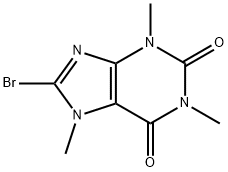
What is xanthobine?
The Uses of xanthobine
8-Bromo-1,3,7-trimethylxanthine is an intermediate in the synthesis of 1,3,7-Trimethyluric Acid (T798000) is a caffeine derivative, and a methyl derivative of uric acid. Detected as a urine marker of caffeine consumption.
Properties of xanthobine
| Melting point: | 208-210°C |
| Boiling point: | 440.1±55.0 °C(Predicted) |
| Density | 1.87±0.1 g/cm3(Predicted) |
| pka | -2?+-.0.20(Predicted) |
| form | Solid |
| color | White |
Safety information for xanthobine
| Signal word | Warning |
| Pictogram(s) |
 Exclamation Mark Irritant GHS07 |
| GHS Hazard Statements |
H302:Acute toxicity,oral |
Computed Descriptors for xanthobine
New Products
Dexamethasone Sodium Phosphate p-Anisaldehyde m-Tolualdehyde 2-Bromobenzaldehyde 4-Fluorobenzaldehyde 1-Propyl-4-piperidone 3-Amino-3-(3-fluorophenyl)propanoic acid Raloxifene EP Impurity D N-Nitroso Nortriptyline Nitroso Irbesartan 2-(p-Tolyl)acetaldehyde Sulfonic acid Impurity 2,2-dibromo-1-cyclopropyl-2-(2-fluorophenyl)ethan-1-one 5-Chloro-2-Methoxy-4-Picoline 2-Amino-6-nitrobenzoic Acid (6-Nitroanthranilic acid) Cis-3,5 Diacetoxy-1-cyclopentene 3-Bromo-2-Methoxy-4-Methylpyridine 2-Amino-5-Chloro-3-Nitro-6-picoline 3-Methoxy-5-methylpyrazin-2-amine Pentachlorobenzonitrile Budesonide Nicotinic acid RAPAMYCIN Alpha CyclodextrinRelated products of tetrahydrofuran
You may like
-
 88660-53-1 >99%View Details
88660-53-1 -
12029-98-0 >98%View Details
12029-98-0 -
1177-87-3 Dexamethasone Acetate >98%View Details
1177-87-3 -
Hydrocortisone 50-23-7 >98%View Details
50-23-7 -
106-43-4 Parachlorotoluene >99%View Details
106-43-4 -
Pyrrolidin >98%View Details
123-75-1 -
cis-p-Menth-2,8-diene-1-ol 7212-40-0 >98%View Details
7212-40-0 -
Para Chloro toluene (PCT) 106-43-4 >99%View Details
106-43-4
Statement: All products displayed on this website are only used for non medical purposes such as industrial applications or scientific research, and cannot be used for clinical diagnosis or treatment of humans or animals. They are not medicinal or edible.