
Veratric Acid-d6
- CAS NO.:1162658-12-9
- Empirical Formula: C9H10O4
- Molecular Weight: 182.1733
- Update Date: 2023-04-23 13:52:06
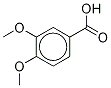
What is Veratric Acid-d6?
The Uses of Veratric Acid-d6
Labelled Veratric Acid, a derivative of Protocatechuic Acid. Veratric Acid is a reagent used in the production of antimicrobial agents, antifeedants, and a variety of other biologically active compounds.It is also intended for use as an internal standard for the quantification of Veratric Acid by GC- or LC-mass spectrometry.
The Uses of Veratric Acid-d6
Labeled Veratric Acid intended for use as an internal standard for the quantification of Veratric Acid by GC- or LC-mass spectrometry.
Properties of Veratric Acid-d6
| Melting point: | 177 - 179 °C |
| storage temp. | Refrigerator |
| solubility | DMSO (Slightly), Methanol (Slightly) |
| form | Solid |
| color | White to Off-White |
Safety information for Veratric Acid-d6
Computed Descriptors for Veratric Acid-d6
New Products
2-Ethoxyphenol Methyl 2-methoxy-5-sulfamoylbenzoate 3,6-Dichloropyridazine Ethyl 2-chloro-2-(2-(4-methoxyphenyl)hydrazono)acetate 3,6-Dichloro-4-Isopropylpyridazine 2-[(2-Ethoxyphenoxy)methyl]oxirane 4-Morpholinoaniline 2-Chloromethyl-6-methyl-pyridine 1-Indanone tert-Butyl ((1R,2S,5S)-2-amino-5-(dimethylcarbamoyl)cyclohexyl)carbamate 2-Pyridinecarboxaldehdye 6-Methyl-2-pyridinemethanol 4-Bromo-2-fluoro-N-methylbenzamide 3-Azetidinecarboxylic acid N-(2-(4-((4-Fluorobenzyl)carbamoyl)-5-hydroxy-6-methoxypyrimidin-2-yl)propan-2-yl)-5-methyl-1,3,4-oxadiazole-2-carboxamide (R)-4-Boc-morpholine-3-carboxylic acid (Required high chiral purity NLT:99.5%) Tetrahydro-3-(2-methyl-2- nitropropyl)-2H-pyran-2-one 3-Bromo-2-fluorobenzonitrile Desoximetasone Boron Triiodide Nicotinic acid RAPAMYCIN Pentachlorobenzonitrile BudesonideYou may like
-
 1589503?95?6 2-((2,6-Difluorobenzyl)(ethoxycarbonyl)amino)-4-((dimethylamino)methyl)-5-(4-nitrophenyl)thiophene-3-carboxylic acid 99%View Details
1589503?95?6 -
2-Chlorophenyl diphenyl chloromethane 99%View Details
42074-68-0 -
6-(chloromethyl)pteridine-2,4-diamine monohydrochloride 82778?08?3 99%View Details
82778?08?3 -
Ethyl (Z)-3-(tetrahydro-2H-pyran-4-yl)acrylate 1373168-67-2 99%View Details
1373168-67-2 -
1,3-Dibromo-5-fluorobenzene 99%View Details
1435-51-2 -
729559-09-5 [N(E)]-N-Ethylidene-2-methyl-2-propanesulfinamide 99%View Details
729559-09-5 -
4-Isopropyl Thiophenol 4946-14-9 99%View Details
4946-14-9 -
2709271-25-8 99%View Details
2709271-25-8
Statement: All products displayed on this website are only used for non medical purposes such as industrial applications or scientific research, and cannot be used for clinical diagnosis or treatment of humans or animals. They are not medicinal or edible.