
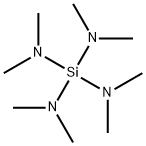
TRIS(DIMETHYLAMINO)SILANE
Synonym(s):TDMAS;Tris(dimethylamino)silane;Tris(dimethylamido)silane;(Me2N)3SiH;N,N,N′,N′,N′′, N′′-Hexamethylsilanetriamine
- CAS NO.:15112-89-7
- Empirical Formula: C6H19N3Si
- Molecular Weight: 161.32
- MDL number: MFCD00048006
- EINECS: 239-165-0
- SAFETY DATA SHEET (SDS)
- Update Date: 2026-05-27 23:18:00
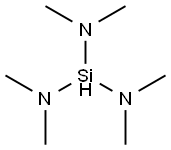
What is TRIS(DIMETHYLAMINO)SILANE?
The Uses of TRIS(DIMETHYLAMINO)SILANE
Tris(dimethylamino)silane (TDMAS) is used as an organosilicon source for the deposition of Si oxynitride; carbonitride; nitride and oxide thin films. It is also used to form multicomponent silicon containing thin films. The depositions can be carried out at low substrate temperatures (<150). The melting point and vapor pressure of TDMAS is in a suitable working range; thus making it a very good vapor deposition precursor.
General Description
Please inquire for quantity, pricing, and packaging options.
Properties of TRIS(DIMETHYLAMINO)SILANE
| Melting point: | <0°C |
| Boiling point: | 145 °C |
| Density | 0,838 g/cm3 |
| refractive index | 1.4247 |
| Flash point: | 25°C |
| form | liquid |
| pka | 10.93±0.70(Predicted) |
| color | colorless to light yellow |
| Specific Gravity | 0.84 |
| Hydrolytic Sensitivity | 8: reacts rapidly with moisture, water, protic solvents |
| Sensitive | air sensitive, moisture sensitive |
| EPA Substance Registry System | N,N,N',N',N'',N''-Hexamethylsilanetriamine (15112-89-7) |
Safety information for TRIS(DIMETHYLAMINO)SILANE
| Signal word | Danger |
| Pictogram(s) |
 Flame Flammables GHS02  Corrosion Corrosives GHS05  Skull and Crossbones Acute Toxicity GHS06 |
| GHS Hazard Statements |
H225:Flammable liquids H261:Substances And Mixtures Which, In Contact With Water,Emit Flammable Gases H302:Acute toxicity,oral H311:Acute toxicity,dermal H314:Skin corrosion/irritation H330:Acute toxicity,inhalation |
| Precautionary Statement Codes |
P210:Keep away from heat/sparks/open flames/hot surfaces. — No smoking. P280:Wear protective gloves/protective clothing/eye protection/face protection. P231+P232:Handle under inert gas. Protect from moisture. P303+P361+P353:IF ON SKIN (or hair): Remove/Take off Immediately all contaminated clothing. Rinse SKIN with water/shower. P305+P351+P338:IF IN EYES: Rinse cautiously with water for several minutes. Remove contact lenses, if present and easy to do. Continuerinsing. |
Computed Descriptors for TRIS(DIMETHYLAMINO)SILANE
New Products
9-Mesityl-10-methylacridinium perchlorate Sulfapyridine Fmoc-OSu (R)-(-)-2-Amino-1-propanol Cyclobutanone 5-bromo-4-fluoro-2-nitrobenzaldehyde 4 pentyn 1 ol N-Vinylformamide Phenethyl cinnamate Pyrrolo[1,2-a]pyrimidine-6-carboxylic acid, 4,6,7,8-tetrahydro-4-oxo-, sodium salt (1:1), (6S) Ethyl 3-phenylpropanoate β-Bromostyrene Methacrylate-PEG-Methacrylate, Mn:35000 2,4-Dihydroxyacetophenone 2-Chloro 5-Fluoro Pyridine Vasicinone 2-Chloroisonicotinic Acid Tween 80 or Polysorbate 80 Methyl trans-4-Aminocyclohexanecarboxylate Hydrochloride N-(4-fluoro-2-methoxy-5-nitrophenyl)-4-(1-methyl-1H-indol-3-yl)pyrimidin-2-amine Pirtobrutinib intd. 4-Nitrobenzotrifluoride 2-Pentyn-1-oL N-(4-Cyano-3-(trifluoromethyl)phenyl)-2-methyloxirane-2-carboxamideRelated products of tetrahydrofuran


You may like
-
 Tris(dimethylamino)silane CAS 15112-89-7View Details
15112-89-7 -
1191-95-3 Cyclobutanone 98+View Details
1191-95-3 -
Fmoc-OSu 98+View Details
82911-69-1 -
(R)-(-)-2-Amino-1-propanol 35320-23-1 98+View Details
35320-23-1 -
1191-95-3 Cyclobutanone 98+View Details
1191-95-3 -
213382-45-7 98+View Details
213382-45-7 -
Fmoc-OSu 98+View Details
82911-69-1 -
(R)-(-)-2-Amino-1-propanol 35320-23-1 98+View Details
35320-23-1
Statement: All products displayed on this website are only used for non medical purposes such as industrial applications or scientific research, and cannot be used for clinical diagnosis or treatment of humans or animals. They are not medicinal or edible.