
Tris(2-chloropropyl) phosphate
- CAS NO.:6145-73-9
- Empirical Formula: C9H18Cl3O4P
- Molecular Weight: 327.56
- MDL number: MFCD00072693
- EINECS: 228-150-4
- SAFETY DATA SHEET (SDS)
- Update Date: 2026-04-10 10:27:21
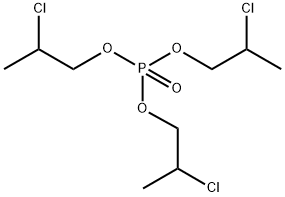
What is Tris(2-chloropropyl) phosphate?
The Uses of Tris(2-chloropropyl) phosphate
Tris(2-chloropropyl) Phosphate, is a human urinary organophosphate flame retardant metabolite.
What are the applications of Application
Tris(2-chloropropyl) Phosphate is A flame retardant chlorinated phosphate ester.
Properties of Tris(2-chloropropyl) phosphate
| Boiling point: | 358.5±22.0 °C(Predicted) |
| Density | 1.294 g/cm3 |
| EPA Substance Registry System | 1-Propanol, 2-chloro-, phosphate (3:1) (6145-73-9) |
Safety information for Tris(2-chloropropyl) phosphate
Computed Descriptors for Tris(2-chloropropyl) phosphate
New Products
6-Hydroxy-2,4-Diaminopyrimidine 2,6-Dipicolic Acid 3-AMINO-3-(2-CHLORO-PHENYL)-PROPIONIC ACID 4-Fluorophenylglycine 1-N-Boc-3-(aminoethyl)azetidine Dimedone 1-Boc-3-(cyanomethyl)azetidine N-BOC-piperidine-4-carboxylic acid 2-Amino-3-Nitro-5-Chloro Pyridine 2-Amino-5-Bromo Pyridine 2,5-Dibromopyridine 2-BROMOACETYL BROMIDE-D2 METHANE SULFONIC ACID-D4 PHOSPORIC ACID-D3 85 W% IN D2O DEUTERIUM OXIDE FOR NMR BENZENE-D6 TOLUENE-D3 5-Acetylsalicylamide 1-(3-Chlorophenyl)-4-(3-Chloropropyl) piperazine hydrochloride 4-(Methyl amino)-3-Nitro benzoic acid 3,4,5-Trimethoxy benzoic acidRelated products of tetrahydrofuran

You may like
-
 67914-85-6 cis-2-(2,4-dichlorophenyl)-2-(1H-1,2,4-triazol-1-ylmethyl)-1,3-dioxolane-4-methanol (IT8)View Details
67914-85-6 -
350-03-8 3-AcetylpyridineView Details
350-03-8 -
6-Chloro-2,4-Diamino pyrimidine 156-83-2View Details
156-83-2 -
1-(4-Aminophenyl)-4-(4-methoxyphenyl)Piperazine 74852-62-3View Details
74852-62-3 -
556-08-1 4-Acetamidobenzoic acidView Details
556-08-1 -
61397-56-6View Details
61397-56-6 -
5-Bromo-2-Chlorobenzoic acid 21739-92-4View Details
21739-92-4 -
15128-52-6View Details
15128-52-6
Statement: All products displayed on this website are only used for non medical purposes such as industrial applications or scientific research, and cannot be used for clinical diagnosis or treatment of humans or animals. They are not medicinal or edible.