
Trifluorothymine
Synonym(s):5-Trifluoromethyluracil
- CAS NO.:54-20-6
- Empirical Formula: C5H3F3N2O2
- Molecular Weight: 180.08
- MDL number: MFCD00006024
- EINECS: 200-197-5
- SAFETY DATA SHEET (SDS)
- Update Date: 2026-05-28 05:03:02
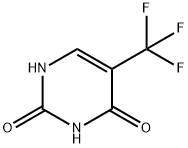
What is Trifluorothymine?
Chemical properties
White to faintly yellow crystalline powder
The Uses of Trifluorothymine
Trifluorothymine is an antitumor and antiviral agent. Trifluorothymine was found in patientsтАЩ urine as a metabolite of Trifluorothymidine as cancer treatment.
What are the applications of Application
Trifluorothymine (5-(Trifluoromethyl)uracil) is an application medicine intermediate widely. It may be used for the synthesis of the cancer therapy drug trifluridine and also can be used for the preparation of the 2, 4-dichloro-5-trifluoromethyluracil.
Synthesis
Uracil and sodium triflate can be used as raw materials to synthesize Trifluorothymine. This reaction uses a mixed solvent of methylene chloride and water as the reaction solvent and tert-butyl hydroperoxide as the catalyst.
Properties of Trifluorothymine
| Melting point: | 245-246 °C(lit.) |
| Density | 1.5484 (estimate) |
| storage temp. | Sealed in dry,Store in freezer, under -20°C |
| solubility | methanol: soluble50mg/mL, clear |
| form | powder to crystal |
| pka | 6.63±0.10(Predicted) |
| color | White to Orange to Green |
| Water Solubility | INSOLUBLE |
| BRN | 612694 |
| CAS DataBase Reference | 54-20-6(CAS DataBase Reference) |
| NIST Chemistry Reference | 2,4(1H,3h)-pyrimidinedione, 5-(trifluoromethyl)-(54-20-6) |
Safety information for Trifluorothymine
| Signal word | Danger |
| Pictogram(s) |
 Skull and Crossbones Acute Toxicity GHS06 |
| GHS Hazard Statements |
H301:Acute toxicity,oral H315:Skin corrosion/irritation H319:Serious eye damage/eye irritation H335:Specific target organ toxicity, single exposure;Respiratory tract irritation |
| Precautionary Statement Codes |
P302+P352:IF ON SKIN: wash with plenty of soap and water. P305+P351+P338:IF IN EYES: Rinse cautiously with water for several minutes. Remove contact lenses, if present and easy to do. Continuerinsing. |
Computed Descriptors for Trifluorothymine
| InChIKey | LMNPKIOZMGYQIU-UHFFFAOYSA-N |
Trifluorothymine manufacturer
SYNTHENTA PVT LTD
2Y
Phone:+91-7416102217
Whatsapp: +91-7416102217
product: 5-(Trifluoromethyl)pyrimidine-2,4(1H,3H)-dione 54-20-6 97-99 %
Archerchem Healthcare Pvt., Ltd. (part of Archerchem Group)
Maharashtra
product: 5-(Trifluoromethyl)uracil
New Products
5-bromo-4-fluoro-2-nitrobenzaldehyde Cyclobutanone (R)-(-)-2-Amino-1-propanol Fmoc-OSu 1-(2-Chloroethyl)pyrrolidine Hydrochloride 2-Amino-2-(4-methylphenyl)acetic acid 2,4-Dihydroxybenzaldehyde Obidoxime hydrochloride API Pyrrolo[1,2-a]pyrimidine-6-carboxylic acid, 4,6,7,8-tetrahydro-4-oxo-, sodium salt (1:1), (6S) Dipropyl disulfide 4 pentyn 1 ol N-Vinylformamide Methacrylate-PEG-Methacrylate, Mn:35000 2,4-Dihydroxyacetophenone 2-Chloro 5-Fluoro Pyridine Vasicinone 2-Chloroisonicotinic Acid Tween 80 or Polysorbate 80 2-Butyn-1-oL 2-Pentyn-1-oL 4-Nitrobenzotrifluoride N-(4-Cyano-3-(trifluoromethyl)phenyl)-2-methyloxirane-2-carboxamide N-(4-fluoro-2-methoxy-5-nitrophenyl)-4-(1-methyl-1H-indol-3-yl)pyrimidin-2-amine Pirtobrutinib intd.Related products of tetrahydrofuran
![[2-13C,15N2]-Trifluorothymine](https://img.chemicalbook.in/)



You may like
-
 54-20-6 5-TRIFLUOROMETHYLURACIL Trifluorothymine 98%View Details
54-20-6 -
 54-20-6 98%View Details
54-20-6 -
 5-(Trifluoromethyl)uracil CAS 54-20-6View Details
54-20-6 -
Trifluorothymine CAS 54-20-6View Details
54-20-6 -
5-(Trifluoromethyl)pyrimidine-2,4(1H,3H)-dione 54-20-6 97-99 %View Details
54-20-6 -
545445-44-1 3-Morpholino-1-(4-(2-oxopiperidin-1-yl) phenyl)-5,6-dihyropyridin-2-(1H)-one 98%View Details
545445-44-1 -
6629-04-5 98%View Details
6629-04-5 -
 1H-Indazole | CAS No. 271-44-3 | Pharmaceutical IntermediateView Details
271-44-3
Statement: All products displayed on this website are only used for non medical purposes such as industrial applications or scientific research, and cannot be used for clinical diagnosis or treatment of humans or animals. They are not medicinal or edible.