
Trifluoromethyl trifluorovinyl ether
- CAS NO.:1187-93-5
- Empirical Formula: C3F6O
- Molecular Weight: 166.02
- MDL number: MFCD00221780
- EINECS: 214-703-7
- SAFETY DATA SHEET (SDS)
- Update Date: 2026-08-28 09:47:34
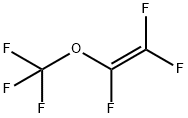
What is Trifluoromethyl trifluorovinyl ether?
General Description
A colorless gas. Heavier than air. Easily liquefied. Contact with the liquid may cause frost bite by evaporative cooling. May asphyxiate by displacing air. A flame may flash back from the source of ignition to the source of a leak. Under prolonged exposure to fire or heat containers may rupture violently and rocket.
Air & Water Reactions
Highly flammable.
Reactivity Profile
Trifluoromethyl trifluorovinyl ether oxidizes readily in air to form unstable peroxides that may explode spontaneously [Bretherick 1979. p.151-154, 164].
Health Hazard
Vapors may cause dizziness or asphyxiation without warning. Some may be irritating if inhaled at high concentrations. Contact with gas or liquefied gas may cause burns, severe injury and/or frostbite. Fire may produce irritating and/or toxic gases.
Fire Hazard
EXTREMELY FLAMMABLE. Will be easily ignited by heat, sparks or flames. Will form explosive mixtures with air. Vapors from liquefied gas are initially heavier than air and spread along ground. CAUTION: Hydrogen (UN1049), Deuterium (UN1957), Hydrogen, refrigerated liquid (UN1966) and Methane (UN1971) are lighter than air and will rise. Hydrogen and Deuterium fires are difficult to detect since they burn with an invisible flame. Use an alternate method of detection (thermal camera, broom handle, etc.) Vapors may travel to source of ignition and flash back. Cylinders exposed to fire may vent and release flammable gas through pressure relief devices. Containers may explode when heated. Ruptured cylinders may rocket.
Flammability and Explosibility
Flammable
Properties of Trifluoromethyl trifluorovinyl ether
| Boiling point: | -22 °C |
| Density | 1.3210 (estimate) |
| vapor pressure | 101.325kPa at 20℃ |
| Water Solubility | 31.5mg/L at 28℃ |
| EPA Substance Registry System | Ethene, 1,1,2-trifluoro-2-(trifluoromethoxy)- (1187-93-5) |
Safety information for Trifluoromethyl trifluorovinyl ether
| Signal word | Danger |
| Pictogram(s) |
 Flame Flammables GHS02  Gas Cylinder Compressed Gases GHS04  Exclamation Mark Irritant GHS07 |
| GHS Hazard Statements |
H220:Flammable gases H280:Gases under pressure H332:Acute toxicity,inhalation |
| Precautionary Statement Codes |
P210:Keep away from heat/sparks/open flames/hot surfaces. — No smoking. P251:Pressurized container: Do not pierce or burn, even after use. P260:Do not breathe dust/fume/gas/mist/vapours/spray. |
Computed Descriptors for Trifluoromethyl trifluorovinyl ether
New Products
5-bromo-4-fluoro-2-nitrobenzaldehyde (R)-(-)-2-Amino-1-propanol Cyclobutanone Fmoc-OSu 1-(2-Chloroethyl)pyrrolidine Hydrochloride 2-Amino-2-(4-methylphenyl)acetic acid β-Bromostyrene Ethyl 3-phenylpropanoate Phenethyl cinnamate Dipropyl disulfide 4 pentyn 1 ol N-Vinylformamide Methacrylate-PEG-Methacrylate, Mn:35000 2,4-Dihydroxyacetophenone 2-Chloro 5-Fluoro Pyridine Vasicinone 2-Chloroisonicotinic Acid Tween 80 or Polysorbate 80 2-Butyn-1-oL 2-Pentyn-1-oL 4-Nitrobenzotrifluoride N-(4-fluoro-2-methoxy-5-nitrophenyl)-4-(1-methyl-1H-indol-3-yl)pyrimidin-2-amine Pirtobrutinib intd. N-(4-Cyano-3-(trifluoromethyl)phenyl)-2-methyloxirane-2-carboxamideRelated products of tetrahydrofuran




You may like
-
 Trifluoromethyl trifluorovinyl ether 99% CAS 1187-93-5View Details
1187-93-5 -
Fmoc-OSu 98+View Details
82911-69-1 -
7250-67-1 1-(2-Chloroethyl)pyrrolidine Hydrochloride 98+View Details
7250-67-1 -
13227-01-5 98+View Details
13227-01-5 -
7250-67-1 1-(2-Chloroethyl)pyrrolidine Hydrochloride 98+View Details
7250-67-1 -
13227-01-5 98+View Details
13227-01-5 -
7250-67-1 1-(2-Chloroethyl)pyrrolidine Hydrochloride 98+View Details
7250-67-1 -
13227-01-5 98+View Details
13227-01-5