
1,3,5-Tribromobenzene
- CAS NO.:626-39-1
- Empirical Formula: C6H3Br3
- Molecular Weight: 314.8
- MDL number: MFCD00000080
- EINECS: 210-947-3
- SAFETY DATA SHEET (SDS)
- Update Date: 2026-06-23 15:38:09
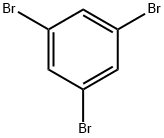
What is 1,3,5-Tribromobenzene?
Chemical properties
Lump powder; Vapour pressure of 1,3,5-tribromobenzene between 295 and 389 K (solid) and 397 and 410 K (liquid). The enthalpies of sublimation and vaporisation were derived from the relationship between vapour pressure and temperature: ΔH°SUB(334.78 K) = 83.54 ± 2 kJ/mol and ΔH°vap(403.23 K) = 58.68 ± 1.5 kJ/mol.
The Uses of 1,3,5-Tribromobenzene
1,3,5-Tribromobenzene, is a reagent that can be used in the preparation of different inhibitors. It is also a substituted Bromobenzene, a general reagent in palladium-catalyzed reactions and in the synthesis of Grignard reagents.
The Uses of 1,3,5-Tribromobenzene
Intermediate in drug manufacturing; organic synthesis; internal standard in analysis of aqueous samples.
What are the applications of Application
1,3,5-Tribromobenzene is an internal standard during derivatization step in determination of cyanide in human plasma and urine by gas chromatography-mass spectrometry
General Description
- 1,3,5-Tribromobenzene(TBB) acts as internal standard during derivatization step in determination of cyanide in human plasma and urine by gas chromatography-mass spectrometry.
- TBB forms molecular complexes of 1:2 stoichiometry with [60]-and [70] fullerenes.
- TBB reacts with perfluoroalkenylzinc reagent in the presence of Pd(Ph3)4 catalyst to yield a novel trifunctional monomer 1,3,5-tris(α, β, β-trifluorovinyl)benzene.
Environmental Fate
Photolytic. Peijnenburg et al. (1992) investigated the photodegradation of a variety of
substituted aromatic halides using a Rayonet RPR-208 photoreactor equipped with 8 RUL 3,000-
? lamps (250–350 nm). The reaction of 1,3,5-tribromobenzene (initial concentration 10-5 M) was
conducted in distilled water and maintained at 20 °C. Though no products were identified, the
investigators reported photohydrolysis was the dominant transformation process. The measured
pseudo-first-order reaction rate constant and corresponding half-life were 0.005/min and 140.5
min., respectively.
Chemical/Physical. 1,3,5-Tribromobenzene will not hydrolyze to any reasonable extent.
Purification Methods
Crystallise it from glacial acetic acid/water (4:1), then wash with chilled EtOH and dry in air. [Beilstein 5 H 213, 5 IV 685.]
Properties of 1,3,5-Tribromobenzene
| Melting point: | 117-121 °C (lit.) |
| Boiling point: | 271 °C (lit.) |
| Density | 2.3515 (estimate) |
| refractive index | 1.6340 (estimate) |
| Flash point: | 271°C |
| storage temp. | Keep in dark place,Sealed in dry,Room Temperature |
| solubility | Soluble in benzene, chloroform, and ether (Weast, 1986) |
| form | Powder |
| color | Almost white to orange-brown |
| Water Solubility | Soluble in hot ethanol and acetic acid. Insoluble in water. |
| BRN | 1858917 |
| CAS DataBase Reference | 626-39-1(CAS DataBase Reference) |
| NIST Chemistry Reference | Benzene, 1,3,5-tribromo-(626-39-1) |
| EPA Substance Registry System | 1,3,5-Tribromobenzene (626-39-1) |
Safety information for 1,3,5-Tribromobenzene
| Signal word | Warning |
| Pictogram(s) |
 Exclamation Mark Irritant GHS07 |
| GHS Hazard Statements |
H315:Skin corrosion/irritation H319:Serious eye damage/eye irritation H335:Specific target organ toxicity, single exposure;Respiratory tract irritation H413:Hazardous to the aquatic environment, long-term hazard |
| Precautionary Statement Codes |
P261:Avoid breathing dust/fume/gas/mist/vapours/spray. P304+P340:IF INHALED: Remove victim to fresh air and Keep at rest in a position comfortable for breathing. P305+P351+P338:IF IN EYES: Rinse cautiously with water for several minutes. Remove contact lenses, if present and easy to do. Continuerinsing. P405:Store locked up. |
Computed Descriptors for 1,3,5-Tribromobenzene
| InChIKey | YWDUZLFWHVQCHY-UHFFFAOYSA-N |
1,3,5-Tribromobenzene manufacturer
ASM Organics
New Products
5-bromo-4-fluoro-2-nitrobenzaldehyde (R)-(-)-2-Amino-1-propanol Cyclobutanone Fmoc-OSu 1-(2-Chloroethyl)pyrrolidine Hydrochloride 2-Amino-2-(4-methylphenyl)acetic acid Obidoxime hydrochloride API Decanoic acid, 2-[4-(phenylmethoxy)phenyl]ethyl ester Piperazine, 1-(3-methoxyphenyl)-, hydrochloride (1:1) 4-Bromo-2,6-difluoroaniline 4 pentyn 1 ol N-Vinylformamide Methacrylate-PEG-Methacrylate, Mn:35000 2,4-Dihydroxyacetophenone 2-Chloro 5-Fluoro Pyridine Vasicinone 2-Chloroisonicotinic Acid Tween 80 or Polysorbate 80 2-Pentyn-1-oL 4-Nitrobenzotrifluoride N-(4-Cyano-3-(trifluoromethyl)phenyl)-2-methyloxirane-2-carboxamide N-(4-fluoro-2-methoxy-5-nitrophenyl)-4-(1-methyl-1H-indol-3-yl)pyrimidin-2-amine Pirtobrutinib intd. 2-Butyn-1-oLRelated products of tetrahydrofuran

You may like
-
 626-39-1 1,3,5-Tribromobenzene 98%View Details
626-39-1 -
 1,3,5-TRI BROMO BENZENE 626-39-1 98%View Details
626-39-1 -
 1,3,5-Tribromobenzene CAS 626-39-1View Details
626-39-1 -
1,3,5-Tribromobenzene pure CAS 626-39-1View Details
626-39-1 -
1,3,5-Tribromobenzene, 98% CAS 626-39-1View Details
626-39-1 -
1,3,5-Tribromobenzene CASView Details
-
1,3,5-Tribromobenzene CAS 626-39-1View Details
626-39-1 -
 1, 3, 5-Tribromobenzene, Packaging Type: DrumView Details
626-39-1