
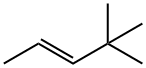
trans-2-Pentene
- CAS NO.:646-04-8
- Empirical Formula: C5H10
- Molecular Weight: 70.13
- MDL number: MFCD00009384
- EINECS: 211-461-4
- SAFETY DATA SHEET (SDS)
- Update Date: 2026-06-23 16:59:16
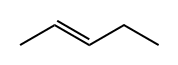
What is trans-2-Pentene?
Chemical properties
clear colourless to slightly yellowish liquid with a disagreeable odor.
The Uses of trans-2-Pentene
Polymerization inhibitor; organic synthesis.
The Uses of trans-2-Pentene
trans-2-Pentene has been used for the calculation of OH levels by the decay method.
General Description
trans-2-Pentene is a colorless liquid with a hydrocarbon smell. It is primarily found in technical grade as a mixture of isomers. It is commonly used as a solvent, in organic synthesis, and as a polymerization inhibitor.
Air & Water Reactions
Highly flammable. Insoluble in water.
Reactivity Profile
The unsaturated aliphatic hydrocarbons, such as 2-PENTENE, are generally much more reactive than the alkanes. Strong oxidizers may react vigorously with them. Reducing agents can react exothermically to release gaseous hydrogen. In the presence of various catalysts (such as acids) or initiators, compounds in this class can undergo very exothermic addition polymerization reactions.
Safety Profile
A dangerous fire and explosion hazard when exposed to heat or flame; can react vigorously with oxidizing materials. When heated to decomposition it emits acrid smoke and irritating fumes.
Source
Schauer et al. (1999) reported trans-2-pentene in a diesel-powered medium-duty truck
exhaust at an emission rate of 50 μg/km.
Schauer et al. (2001) measured organic compound emission rates for volatile organic
compounds, gas-phase semi-volatile organic compounds, and particle-phase organic compounds
from the residential (fireplace) combustion of pine, oak, and eucalyptus. The gas-phase emission
rate of trans-2-pentene was 16.0 mg/kg of pine burned. Emission rates of trans-2-pentene were
not measured during the combustion of oak and eucalyptus.
California Phase II reformulated gasoline contained trans-2-pentene at a concentration of 4.12
g/kg. Gas-phase tailpipe emission rates from gasoline-powered automobiles with and without
catalytic converters were 0.71 and 77.4 mg/km, respectively (Schauer et al., 2002).
Environmental Fate
Chemical/Physical. Complete combustion in air yields carbon dioxide and water.
Purification Methods
It is treated as above and washed with water, dried over anhydrous Na2CO3, and fractionally distilled. The middle cut is purified by two passes of fractional melting. [Beilstein 1 IV 814.]
Properties of trans-2-Pentene
| Melting point: | -140 °C (lit.) |
| Boiling point: | 37 °C (lit.) |
| Density | 0.649 g/mL at 25 °C (lit.) |
| vapor pressure | 8.06 psi ( 20 °C) |
| refractive index | n |
| Flash point: | −50 °F |
| storage temp. | 2-8°C |
| solubility | Soluble in alcohol, benzene, and ether (Weast, 1986) |
| pka | >14 (Schwarzenbach et al., 1993) |
| form | clear liquid |
| color | cis Form: Liquid |
| Water Solubility | 203 mg/kg at 25 °C (shake flask-GC, McAuliffe, 1966) |
| Merck | 14,7123 |
| BRN | 1718795 |
| Henry's Law Constant | 0.234 at 25 °C (Hine and Mookerjee, 1975) |
| CAS DataBase Reference | 646-04-8(CAS DataBase Reference) |
| EPA Substance Registry System | trans-2-Pentene (646-04-8) |
Safety information for trans-2-Pentene
| Signal word | Danger |
| Pictogram(s) |
 Flame Flammables GHS02  Exclamation Mark Irritant GHS07  Health Hazard GHS08 |
| GHS Hazard Statements |
H224:Flammable liquids H304:Aspiration hazard H315:Skin corrosion/irritation H319:Serious eye damage/eye irritation H335:Specific target organ toxicity, single exposure;Respiratory tract irritation |
| Precautionary Statement Codes |
P210:Keep away from heat/sparks/open flames/hot surfaces. — No smoking. P233:Keep container tightly closed. P331:Do NOT induce vomiting. P301+P310:IF SWALLOWED: Immediately call a POISON CENTER or doctor/physician. P303+P361+P353:IF ON SKIN (or hair): Remove/Take off Immediately all contaminated clothing. Rinse SKIN with water/shower. P403+P233:Store in a well-ventilated place. Keep container tightly closed. |
Computed Descriptors for trans-2-Pentene
New Products
5-bromo-4-fluoro-2-nitrobenzaldehyde (R)-(-)-2-Amino-1-propanol Cyclobutanone Fmoc-OSu 1-(2-Chloroethyl)pyrrolidine Hydrochloride 2-Amino-2-(4-methylphenyl)acetic acid β-Bromostyrene Ethyl 3-phenylpropanoate Phenethyl cinnamate Dipropyl disulfide 4 pentyn 1 ol N-Vinylformamide Methacrylate-PEG-Methacrylate, Mn:35000 2,4-Dihydroxyacetophenone 2-Chloro 5-Fluoro Pyridine Vasicinone 2-Chloroisonicotinic Acid Tween 80 or Polysorbate 80 2-Butyn-1-oL 2-Pentyn-1-oL 4-Nitrobenzotrifluoride N-(4-fluoro-2-methoxy-5-nitrophenyl)-4-(1-methyl-1H-indol-3-yl)pyrimidin-2-amine Pirtobrutinib intd. N-(4-Cyano-3-(trifluoromethyl)phenyl)-2-methyloxirane-2-carboxamideRelated products of tetrahydrofuran




You may like
-
 trans-2-Pentene CAS 646-04-8View Details
646-04-8 -
trans-2-Pentene CAS 646-04-8View Details
646-04-8 -
trans-2-Pentene CAS 646-04-8View Details
646-04-8 -
7250-67-1 1-(2-Chloroethyl)pyrrolidine Hydrochloride 98+View Details
7250-67-1 -
7250-67-1 1-(2-Chloroethyl)pyrrolidine Hydrochloride 98+View Details
7250-67-1 -
13227-01-5 98+View Details
13227-01-5 -
7250-67-1 1-(2-Chloroethyl)pyrrolidine Hydrochloride 98+View Details
7250-67-1 -
13227-01-5 98+View Details
13227-01-5