
Tetrathiafulvalene
Synonym(s):Δ2,2′-Bi-1,3-dithiole;TTF
- CAS NO.:31366-25-3
- Empirical Formula: C6H4S4
- Molecular Weight: 204.34
- MDL number: MFCD00005492
- EINECS: 250-593-7
- SAFETY DATA SHEET (SDS)
- Update Date: 2026-09-12 18:54:13
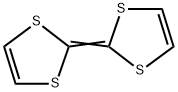
What is Tetrathiafulvalene?
Chemical properties
ORANGE TO BROWNISH CRYSTALS OR CRYSTALLINE POWDER
The Uses of Tetrathiafulvalene
Tetrathiafulvalene, holds wide application in HPLC, NMR. This heterocyclic compound contributed to the development of molecular electronics. They are used as a organic super conductors.
The Uses of Tetrathiafulvalene
Electron donor for supramolecular synthesis,1 charge-transfer complex synthesis2 with 7,7,8,8-tetracyanoquinodimethane (cat. no. 157635), and for electron transfer to diazonium salts.3
The Uses of Tetrathiafulvalene
Molecular sensors; radical catalyst.
Definition
ChEBI: Tetrathiafulvalene is a member of the class of fulvalenes that is ethene substituted by 1,3-dithiol-2-ylidene groups at positions 1 and 2. It is an organosulfur heterocyclic compound and a member of fulvalenes.
General Description
Tetrathiafulvalene (TTF) is an electron-donor which consists of oligomers, dendrimers and polymers which can be used in the formation of redox macromolecules.
Purification Methods
Recrystallise it from cyclohexane/hexane under an argon atmosphere [Kauzlarich et al. J Am Chem Soc 109 4561 1987]. [Beilstein 19/11 V 380.]
Properties of Tetrathiafulvalene
| Melting point: | 116-119 °C (lit.) |
| Boiling point: | 90℃ (1 Torr) |
| Density | 1.448 (estimate) |
| refractive index | 1.6000 (estimate) |
| storage temp. | 2-8°C |
| form | Crystals or Crystalline Powder |
| color | Orange to brownish |
| Water Solubility | It is insoluble in water. Soluble in organic solvents. |
| Sensitive | Air & Light Sensitive |
| λmax | 369nm(CHCl3)(lit.) |
| Merck | 14,9242 |
| BRN | 1617956 |
| CAS DataBase Reference | 31366-25-3(CAS DataBase Reference) |
| EPA Substance Registry System | 1,3-Dithiole, 2-(1,3-dithiol-2-ylidene)- (31366-25-3) |
Safety information for Tetrathiafulvalene
| Signal word | Warning |
| Pictogram(s) |
 Exclamation Mark Irritant GHS07 |
| GHS Hazard Statements |
H317:Sensitisation, Skin |
| Precautionary Statement Codes |
P261:Avoid breathing dust/fume/gas/mist/vapours/spray. P321:Specific treatment (see … on this label). P333+P313:IF SKIN irritation or rash occurs: Get medical advice/attention. |
Computed Descriptors for Tetrathiafulvalene
| InChIKey | FHCPAXDKURNIOZ-UHFFFAOYSA-N |
New Products
5-bromo-4-fluoro-2-nitrobenzaldehyde (R)-(-)-2-Amino-1-propanol Cyclobutanone Fmoc-OSu 1-(2-Chloroethyl)pyrrolidine Hydrochloride 2-Amino-2-(4-methylphenyl)acetic acid Obidoxime hydrochloride API Decanoic acid, 2-[4-(phenylmethoxy)phenyl]ethyl ester Piperazine, 1-(3-methoxyphenyl)-, hydrochloride (1:1) 4-Bromo-2,6-difluoroaniline 4 pentyn 1 ol N-Vinylformamide Methacrylate-PEG-Methacrylate, Mn:35000 2,4-Dihydroxyacetophenone 2-Chloro 5-Fluoro Pyridine Vasicinone 2-Chloroisonicotinic Acid Tween 80 or Polysorbate 80 2-Pentyn-1-oL 4-Nitrobenzotrifluoride N-(4-Cyano-3-(trifluoromethyl)phenyl)-2-methyloxirane-2-carboxamide N-(4-fluoro-2-methoxy-5-nitrophenyl)-4-(1-methyl-1H-indol-3-yl)pyrimidin-2-amine Pirtobrutinib intd. 2-Butyn-1-oLRelated products of tetrahydrofuran
![TETRAKIS(OCTADECYLTHIO)TETRATHIAFULVALENE,Tetrakis(octadecylthio)tetrathiafulvalene [Organic Electronic Material]](https://img.chemicalbook.in/CAS/GIF/105782-53-4.gif)

You may like
-
 Tetrathiafulvalene (purified by sublimation) CAS 31366-25-3View Details
31366-25-3 -
Tetrathiafulvalene 98% CAS 31366-25-3View Details
31366-25-3 -
7250-67-1 1-(2-Chloroethyl)pyrrolidine Hydrochloride 98+View Details
7250-67-1 -
13227-01-5 98+View Details
13227-01-5 -
7250-67-1 1-(2-Chloroethyl)pyrrolidine Hydrochloride 98+View Details
7250-67-1 -
13227-01-5 98+View Details
13227-01-5 -
7250-67-1 1-(2-Chloroethyl)pyrrolidine Hydrochloride 98+View Details
7250-67-1 -
13227-01-5 98+View Details
13227-01-5