
TETRAMETHYLURIC ACID
- CAS NO.:2309-49-1
- Empirical Formula: C9H12N4O3
- Molecular Weight: 224.22
- MDL number: MFCD00042781
- EINECS: 218-994-1
- SAFETY DATA SHEET (SDS)
- Update Date: 2026-05-28 00:47:10
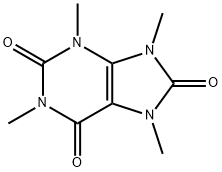
What is TETRAMETHYLURIC ACID?
The Uses of TETRAMETHYLURIC ACID
Tetramethyluric acid is an impurity of caffeine. Caffeine is a bitter, white crystalline xanthine alkaloid that acts as a stimulant drug and a reversible acetylcholinesterase inhibitor. Caffeine is found in varying quantities in the seeds, leaves, and fruit of some plants, where it acts as a natural pesticide that paralyzes and kills certain insects feeding on the plants. In humans, caffeine acts as a central nervous system stimulant, temporarily warding off drowsiness and restoring alertness. Caffeine is a cardiac and respiratory stimulant; diuretic. Caffeine is toxic at sufficiently high doses.
Definition
ChEBI: 1,3,7,9-tetramethyluric acid is an oxopurine that is uric acid in which the hydrogens at positions 1,3,7 and 9 are replaced by methyl groups. It is a purine alkaloid that is found in Chinese tea known as kucha (Camellia assamica var. kucha) and exhibits anti-inflammatory and analgesic properties. It has a role as a plant metabolite, an anti-inflammatory agent, an analgesic and a human xenobiotic metabolite. It is an oxopurine and a purine alkaloid. It is functionally related to a 7,9-dihydro-1H-purine-2,6,8(3H)-trione.
Purification Methods
Crystallise the uric acid from H2O or MeOH. [Beilstein 26 H 532, 26 I 156, 26 II 302, 21 III/IV 2623.]
Properties of TETRAMETHYLURIC ACID
| Melting point: | 226℃ |
| Boiling point: | 365.61°C (rough estimate) |
| Density | 1.3055 (rough estimate) |
| refractive index | 1.6300 (estimate) |
| storage temp. | Sealed in dry,Room Temperature |
| solubility | Chloroform (Slightly), Methanol (Slightly) |
| pka | -1.93±0.20(Predicted) |
| form | Solid |
| color | White to Off-White |
| Water Solubility | 33mg/L(room temperature) |
Safety information for TETRAMETHYLURIC ACID
| Signal word | Warning |
| Pictogram(s) |
 Exclamation Mark Irritant GHS07 |
| GHS Hazard Statements |
H302:Acute toxicity,oral H315:Skin corrosion/irritation H319:Serious eye damage/eye irritation H335:Specific target organ toxicity, single exposure;Respiratory tract irritation |
| Precautionary Statement Codes |
P261:Avoid breathing dust/fume/gas/mist/vapours/spray. P305+P351+P338:IF IN EYES: Rinse cautiously with water for several minutes. Remove contact lenses, if present and easy to do. Continuerinsing. |
Computed Descriptors for TETRAMETHYLURIC ACID
New Products
9-Mesityl-10-methylacridinium perchlorate Sulfapyridine Fmoc-OSu (R)-(-)-2-Amino-1-propanol Cyclobutanone 5-bromo-4-fluoro-2-nitrobenzaldehyde 4 pentyn 1 ol N-Vinylformamide Phenethyl cinnamate Pyrrolo[1,2-a]pyrimidine-6-carboxylic acid, 4,6,7,8-tetrahydro-4-oxo-, sodium salt (1:1), (6S) Ethyl 3-phenylpropanoate β-Bromostyrene Methacrylate-PEG-Methacrylate, Mn:35000 2,4-Dihydroxyacetophenone 2-Chloro 5-Fluoro Pyridine Vasicinone 2-Chloroisonicotinic Acid Tween 80 or Polysorbate 80 Methyl trans-4-Aminocyclohexanecarboxylate Hydrochloride N-(4-fluoro-2-methoxy-5-nitrophenyl)-4-(1-methyl-1H-indol-3-yl)pyrimidin-2-amine Pirtobrutinib intd. 4-Nitrobenzotrifluoride 2-Pentyn-1-oL N-(4-Cyano-3-(trifluoromethyl)phenyl)-2-methyloxirane-2-carboxamideRelated products of tetrahydrofuran
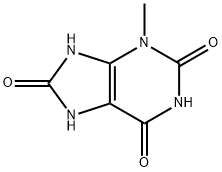
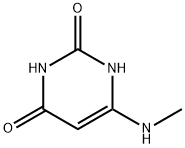
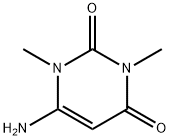

You may like
-
 Tetramethyluric acid 95% CAS 2309-49-1View Details
2309-49-1 -
1191-95-3 Cyclobutanone 98+View Details
1191-95-3 -
Fmoc-OSu 98+View Details
82911-69-1 -
(R)-(-)-2-Amino-1-propanol 35320-23-1 98+View Details
35320-23-1 -
1191-95-3 Cyclobutanone 98+View Details
1191-95-3 -
213382-45-7 98+View Details
213382-45-7 -
Fmoc-OSu 98+View Details
82911-69-1 -
(R)-(-)-2-Amino-1-propanol 35320-23-1 98+View Details
35320-23-1