
Tetraethyltin
- CAS NO.:597-64-8
- Empirical Formula: C8H20Sn
- Molecular Weight: 234.95
- MDL number: MFCD00009020
- EINECS: 209-906-2
- SAFETY DATA SHEET (SDS)
- Update Date: 2026-09-12 18:52:04
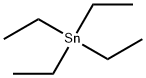
What is Tetraethyltin?
Chemical properties
clear colorless liquid
Chemical properties
Tetraethyltin is a colorless organotin liquid.
The Uses of Tetraethyltin
Tetraethyltin is used as catalyst for olefin polymerization and to produce other organotin compounds. It is also used in the electronics industry and as a preservative for wood, textiles, paper, and leather.
General Description
Colorless liquid. Used as biocides, bactericides, fungicides and insecticides; preservatives for wood, textile, paper, and leather. Not registered as a pesticide in the U.S.
Air & Water Reactions
TETRAETHYLTIN tends to ignite in air.
Reactivity Profile
When heated to decomposition, TETRAETHYLTIN emits acrid smoke and fumes. (nonspecific -- Organic Tin Compounds) Avoid strong oxidizers. [EPA, 1998].
Hazard
Toxic material.
Health Hazard
Toxic hazard rating is high for oral, intravenous, intraperitoneal administration. TETRAETHYLTIN causes swelling of the brain and spinal cord.
Fire Hazard
When heated to decomposition, TETRAETHYLTIN emits acrid smoke and fumes. (Non-Specific -- Organic Tin Compounds) Avoid strong oxidizers.
Safety Profile
Poison by ingestion, intravenous, and intraperitoneal routes. When heated to decomposition it emits acrid smoke and irritating fumes. See also TIN COMPOUNDS.
Potential Exposure
Used as biocide, bactericide, fungicide and insecticide; preservative for wood, textile, paper, and leather. Not registered as a pesticide in the United States.
Shipping
UN3384 Toxic by inhalation liquid, flammable, n.o.s. with an LC50 ≤1000 mL/m3 and saturated vapor concentration ≥ to 10 LC50, Hazard class: 6.1; Labels: 6.1-Poisonous materials, 3-Flammable liquid, Technical Name Required, Inhalation Hazard Zone B. UN2788Organotin compounds, liquid, n.o.s., Hazard Class: 6.1; Labels: 6.1-Poisonous materials.
Incompatibilities
A strong reducing agent. Incompatible with oxidizers (chlorates, nitrates, peroxides, permanganates, perchlorates, chlorine, bromine, fluorine, etc.); contact may cause fires or explosions. Keep away from alkaline materials, strong bases, strong acids, oxoacids, epoxides.
Waste Disposal
In accordance with 40CFR 165 recommendations for the disposal of pesticides and pesticide containers. Must be disposed properly by following package label directions or by contacting your local or federal environmental control agency, or by contacting your regional EPA office.
Properties of Tetraethyltin
| Melting point: | −112 °C(lit.) |
| Boiling point: | 181 °C(lit.) |
| Density | 1.187 g/mL at 25 °C(lit.) |
| refractive index | n |
| Flash point: | 128 °F |
| storage temp. | Refrigerator (+4°C) + Poison room |
| solubility | Chloroform (Sparingly), Methanol (Slightly) |
| form | Liquid |
| Specific Gravity | 1.187 |
| Water Solubility | Insoluble in water. Soluble in alcohol and ether |
| Dielectric constant | 2.7999999999999998 |
| CAS DataBase Reference | 597-64-8(CAS DataBase Reference) |
| EPA Substance Registry System | Tetraethyltin (597-64-8) |
Safety information for Tetraethyltin
| Pictogram(s) |
 Flame Flammables GHS02  Skull and Crossbones Acute Toxicity GHS06  Environment GHS09 |
| GHS Hazard Statements |
H226:Flammable liquids H300:Acute toxicity,oral H310:Acute toxicity,dermal H330:Acute toxicity,inhalation H400:Hazardous to the aquatic environment, acute hazard H410:Hazardous to the aquatic environment, long-term hazard |
| Precautionary Statement Codes |
P273:Avoid release to the environment. P309:IF exposed or if you feel unwell: P310:Immediately call a POISON CENTER or doctor/physician. P303+P361+P353:IF ON SKIN (or hair): Remove/Take off Immediately all contaminated clothing. Rinse SKIN with water/shower. |
Computed Descriptors for Tetraethyltin
New Products
9-Mesityl-10-methylacridinium perchlorate Sulfapyridine Fmoc-OSu (R)-(-)-2-Amino-1-propanol Cyclobutanone 5-bromo-4-fluoro-2-nitrobenzaldehyde Phenethyl cinnamate Obidoxime hydrochloride API Pyrrolo[1,2-a]pyrimidine-6-carboxylic acid, 4,6,7,8-tetrahydro-4-oxo-, sodium salt (1:1), (6S) Dipropyl disulfide N-Vinylformamide 4 pentyn 1 ol Methacrylate-PEG-Methacrylate, Mn:35000 2,4-Dihydroxyacetophenone 2-Chloro 5-Fluoro Pyridine Vasicinone 2-Chloroisonicotinic Acid Tween 80 or Polysorbate 80 Carbozantinib intermediate(n-1) N-(4-fluoro-2-methoxy-5-nitrophenyl)-4-(1-methyl-1H-indol-3-yl)pyrimidin-2-amine Pirtobrutinib intd. N-(4-Cyano-3-(trifluoromethyl)phenyl)-2-methyloxirane-2-carboxamide 2-Pentyn-1-oL 4-NitrobenzotrifluorideRelated products of tetrahydrofuran

You may like
-
 Tetraethyltin CAS 597-64-8View Details
597-64-8 -
1191-95-3 Cyclobutanone 98+View Details
1191-95-3 -
Fmoc-OSu 98+View Details
82911-69-1 -
(R)-(-)-2-Amino-1-propanol 35320-23-1 98+View Details
35320-23-1 -
1191-95-3 Cyclobutanone 98+View Details
1191-95-3 -
213382-45-7 98+View Details
213382-45-7 -
Fmoc-OSu 98+View Details
82911-69-1 -
(R)-(-)-2-Amino-1-propanol 35320-23-1 98+View Details
35320-23-1