
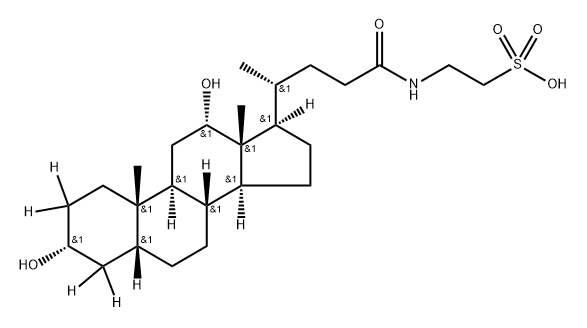
Taurodeoxycholic-d4 Acid
- CAS NO.:1332881-65-8
- Empirical Formula: C26H45NO6S
- Molecular Weight: 499.71
- Update Date: 2025-04-17 18:22:24
What is Taurodeoxycholic-d4 Acid?
Biological Activity
Taurodeoxycholic acid-d4 (TDCA-d4) is intended for use as an internal standard for the quantification of taurodeoxycholic acid by GC- or LC-MS. TDCA is a taurine-conjugated form of the secondary bile acid deoxycholic acid .1 TDCA stimulates chloride ion secretion through calcium-activated chloride ion channels and cystic fibrosis transmembrane conductance regulator (CFTR) in Calu-3 airway epithelial cell monolayers when applied basolaterally.2 Serum levels of taurodeoxycholic acid increase approximately 5-fold within two hours during an oral lipid tolerance test in humans.1 TDCA-d4 MaxSpec? standard is a quantitative grade standard of TDCA-d4 that has been prepared specifically for mass spectrometry and related applications where quantitative reproducibility is required. The solution has been prepared gravimetrically and is supplied in a deactivated glass ampule sealed under argon. The concentration was verified by comparison to an independently prepared calibration standard. The verified concentration is provided on the certificate of analysis. This TDCA-d4 MaxSpec? standard is guaranteed to meet identity, purity, stability, and concentration specifications and is provided with a batch-specific certificate of analysis. Ongoing stability testing is performed to ensure the concentration remains accurate throughout the shelf life of the product. Note: The amount of solution added to the vial is in excess of the listed amount. Therefore, it is necessary to accurately measure volumes for preparation of calibration standards. Follow recommended storage and handling conditions to maintain product quality.
References
1.Schmid, A., Neumann, H., Karrasch, T., et al.Bile acid metabolome after an oral lipid tolerance test by liquid chromatography-tandem mass spectrometry (LC-MS/MS)PLoS One11(2)e0148869(2016) 2.Hendrick, S.M., Mroz, M.S., Greene, C.M., et al.Bile acids stimulate chloride secretion through CFTR and calcium-activated Cl- channels in Calu-3 airway epithelial cellsAm. J. Physiol. Lung. Cell. Mol. Physiol.307(5)L407-L418(2014)
Properties of Taurodeoxycholic-d4 Acid
| storage temp. | -20°C |
Safety information for Taurodeoxycholic-d4 Acid
Computed Descriptors for Taurodeoxycholic-d4 Acid
New Products
2-Ethoxyphenol Methyl 2-methoxy-5-sulfamoylbenzoate 3,6-Dichloropyridazine Ethyl 2-chloro-2-(2-(4-methoxyphenyl)hydrazono)acetate 3,6-Dichloro-4-Isopropylpyridazine 2-[(2-Ethoxyphenoxy)methyl]oxirane 4-Morpholinoaniline 2-Chloromethyl-6-methyl-pyridine 1-Indanone tert-Butyl ((1R,2S,5S)-2-amino-5-(dimethylcarbamoyl)cyclohexyl)carbamate 2-Pyridinecarboxaldehdye 6-Methyl-2-pyridinemethanol 4-Bromo-2-fluoro-N-methylbenzamide 3-Azetidinecarboxylic acid N-(2-(4-((4-Fluorobenzyl)carbamoyl)-5-hydroxy-6-methoxypyrimidin-2-yl)propan-2-yl)-5-methyl-1,3,4-oxadiazole-2-carboxamide (R)-4-Boc-morpholine-3-carboxylic acid (Required high chiral purity NLT:99.5%) Tetrahydro-3-(2-methyl-2- nitropropyl)-2H-pyran-2-one 3-Bromo-2-fluorobenzonitrile Desoximetasone Boron Triiodide Nicotinic acid RAPAMYCIN Pentachlorobenzonitrile BudesonideYou may like
-
 1589503?95?6 2-((2,6-Difluorobenzyl)(ethoxycarbonyl)amino)-4-((dimethylamino)methyl)-5-(4-nitrophenyl)thiophene-3-carboxylic acid 99%View Details
1589503?95?6 -
2-Chlorophenyl diphenyl chloromethane 99%View Details
42074-68-0 -
6-(chloromethyl)pteridine-2,4-diamine monohydrochloride 82778?08?3 99%View Details
82778?08?3 -
Ethyl (Z)-3-(tetrahydro-2H-pyran-4-yl)acrylate 1373168-67-2 99%View Details
1373168-67-2 -
1,3-Dibromo-5-fluorobenzene 99%View Details
1435-51-2 -
729559-09-5 [N(E)]-N-Ethylidene-2-methyl-2-propanesulfinamide 99%View Details
729559-09-5 -
4-Isopropyl Thiophenol 4946-14-9 99%View Details
4946-14-9 -
2709271-25-8 99%View Details
2709271-25-8