
Swertiamarine
Synonym(s):(4aR,5R,6S)-5-Ethenyl-6-(β-D -glucopyranosyloxy)-4,4a,5,6-tetrahydro-4a-hydroxy1H,3H-pyrano[3,4-c]pyran-1-one;4,4a,5,6-Tetrahydro-4aα-hydroxy-1-oxo-5β-vinyl-1H,3H-pyrano[3,4-c]pyran-6-yl β-D -glucopyranoside;Swertiamarin;Swertiamarine;Swertiamaroside
- CAS NO.:17388-39-5
- Empirical Formula: C16H22O10
- Molecular Weight: 374.34
- MDL number: MFCD07783984
- SAFETY DATA SHEET (SDS)
- Update Date: 2026-08-07 18:09:57
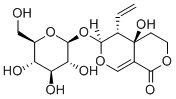
What is Swertiamarine?
The Uses of Swertiamarine
Swertimarine is an extract from Enicostemma littorale which is an herb used in the treatment of type 1 and 2 diabetes. Used to sensitize the cells to hypolipidemic conditions and insulin.
Definition
ChEBI: Swertiamarin is a glycoside.
Properties of Swertiamarine
| Melting point: | 113-114° |
| Boiling point: | 649.3±55.0 °C(Predicted) |
| alpha | D20 -127° (c = 1 in 96% ethanol) |
| Density | 1.57±0.1 g/cm3(Predicted) |
| storage temp. | Sealed in dry,Store in freezer, under -20°C |
| solubility | DMSO : 250 mg/mL (667.84 mM; Need ultrasonic) |
| form | neat |
| pka | 11.56±0.60(Predicted) |
| form | Solid |
| color | White to Yellow to Orange |
| λmax | 238nm(MeOH)(lit.) |
| Merck | 14,9010 |
| BRN | 55278 |
| Stability: | Hygroscopic |
| CAS DataBase Reference | 17388-39-5(CAS DataBase Reference) |
Safety information for Swertiamarine
| Signal word | Danger |
| Pictogram(s) |
 Corrosion Corrosives GHS05  Skull and Crossbones Acute Toxicity GHS06  Health Hazard GHS08  Environment GHS09 |
| GHS Hazard Statements |
H301:Acute toxicity,oral H314:Skin corrosion/irritation H317:Sensitisation, Skin H351:Carcinogenicity H410:Hazardous to the aquatic environment, long-term hazard |
| Precautionary Statement Codes |
P201:Obtain special instructions before use. P202:Do not handle until all safety precautions have been read and understood. P260:Do not breathe dust/fume/gas/mist/vapours/spray. P264:Wash hands thoroughly after handling. P264:Wash skin thouroughly after handling. P270:Do not eat, drink or smoke when using this product. P272:Contaminated work clothing should not be allowed out of the workplace. P273:Avoid release to the environment. P280:Wear protective gloves/protective clothing/eye protection/face protection. P391:Collect spillage. Hazardous to the aquatic environment P301+P330+P331:IF SWALLOWED: Rinse mouth. Do NOT induce vomiting. P303+P361+P353:IF ON SKIN (or hair): Remove/Take off Immediately all contaminated clothing. Rinse SKIN with water/shower. P308+P313:IF exposed or concerned: Get medical advice/attention. P333+P313:IF SKIN irritation or rash occurs: Get medical advice/attention. P405:Store locked up. |
Computed Descriptors for Swertiamarine
| InChIKey | HEYZWPRKKUGDCR-QBXMEVCASA-N |
New Products
9-Mesityl-10-methylacridinium perchlorate Sulfapyridine Fmoc-OSu (R)-(-)-2-Amino-1-propanol Cyclobutanone 5-bromo-4-fluoro-2-nitrobenzaldehyde 4 pentyn 1 ol N-Vinylformamide Phenethyl cinnamate Pyrrolo[1,2-a]pyrimidine-6-carboxylic acid, 4,6,7,8-tetrahydro-4-oxo-, sodium salt (1:1), (6S) Ethyl 3-phenylpropanoate β-Bromostyrene Methacrylate-PEG-Methacrylate, Mn:35000 2,4-Dihydroxyacetophenone 2-Chloro 5-Fluoro Pyridine Vasicinone 2-Chloroisonicotinic Acid Tween 80 or Polysorbate 80 5-Bromo-1-Pentyne 1-(2-Methyl-5-nitrophenyl)guanidine Nitrate Methyl trans-4-Aminocyclohexanecarboxylate Hydrochloride 2-Pentyn-1-oL 4-Nitrobenzotrifluoride N-(4-Cyano-3-(trifluoromethyl)phenyl)-2-methyloxirane-2-carboxamideRelated products of tetrahydrofuran
You may like
-
 Swertiamarin 95% CAS 17388-39-5View Details
17388-39-5 -
Swertiamarin CAS 17388-39-5View Details
17388-39-5 -
Swertiamarine CAS 17388-39-5View Details
17388-39-5 -
Swertiamarin CAS 17388-39-5View Details
17388-39-5 -
1191-95-3 Cyclobutanone 98+View Details
1191-95-3 -
213382-45-7 98+View Details
213382-45-7 -
Fmoc-OSu 98+View Details
82911-69-1 -
(R)-(-)-2-Amino-1-propanol 35320-23-1 98+View Details
35320-23-1
Statement: All products displayed on this website are only used for non medical purposes such as industrial applications or scientific research, and cannot be used for clinical diagnosis or treatment of humans or animals. They are not medicinal or edible.