
Sulfoxaflor
- CAS NO.:946578-00-3
- Empirical Formula: C10H10F3N3OS
- Molecular Weight: 277.27
- MDL number: MFCD22572331
- EINECS: 202-303-5
- SAFETY DATA SHEET (SDS)
- Update Date: 2026-07-31 15:25:14
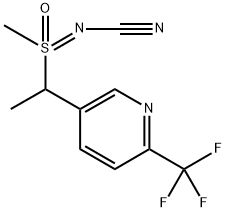
What is Sulfoxaflor?
Description
Sulfoxaflor is an insecticide that is used to control aphids in field crops and favourably compares with imidacloprid in efficiacy. It is relatively volatile, whilst potentially mobile in soils it has a low potential for leaching due to its rapid degradation rate. It has a high potential to bioaccumulate, generally moderately toxic to birds and mammals and has a low toxicity to most aquatic species. It is toxic to honeybees and earthworms
Description
Sulfoxaflor is a pesticide that kills insects by attacking their central nervous system. It is a member of the sulfoximine family of insecticides. In 2013, the US Environmental Protection Agency (EPA) approved this Dow AgroSciences product for use in the United States. It is also registered in some Central American and east Asian countries.
The EPA registered sulfoxaflor despite its potential toxicity to honeybees. It recommended that the insecticide not be used when flowering crops are attracting bees.
A consortium of beekeeping trade groups sued the EPA shortly after registration, believing that sulfoxaflor would exacerbate the declining bee population. In September 2015, a federal appeals court overturned the registration?by ruling that the supporting studies were insufficient to demonstrate that sulfoxaflor does not cause environmental harm. Dow says it will perform additional studies and may appeal the court’s decision.
History
lt was first registered by EPA for emergency use on cotton to controltarnished plant bug, Lygus lineolaris in the state of Mississippi,Arkansas,Louisiana, and Tennessee in June 2012. lts use was extended to other cropsin 2013.Sulfoxaflor is registered for use in Minnesota in June 2013.
The Uses of Sulfoxaflor
Sulfoxaflor-d3 is the isotope analog of Sulfoxaflor. Sulfoxaflor, is a new insecticide which acts as an insect neurotoxin, and is the only member of class of chemicals called the sulfoximines which act on the central nervous system of insects with much lower toxicity to mammals.
Definition
ChEBI: [methyl(oxido){1-[6-(trifluoromethyl)pyridin-3-yl]ethyl}-lambda(6)-sulfanylidene]cyanamide is a member of the class of pyridines that is 5-ethyl-2-trifluoromethylpyridine in which the ethyl group is substituted at position 1 by an N-cyano-S-methylsulfonimidoyl group. The insecticide sulfoxalor is a mixture of the four possible stereoisomers arising from the two tetrahedral stereocentres. It is a member of pyridines, a sulfoximide, a nitrile and an organofluorine compound.
Benefits
Sulfoxaflor may be registered for use on the following major crops inMinnesota: soybeans, potatoes, wheat. According to UMN extension,sulfoxaflor worked well against aphids in soybean and potatoes. It will beof use against piercing/sucking insects such as aphids, leafhoppers, plantbugs, etc. lt is not labeled for residential uses.
Toxicology
EPA's screening models generote high-end, conservative exposure estimates for active ingredients and toxicologically significant degrodates. Model inputs include annual usage ot moximum use rates, maximum treated acres, maximum food residues, peak runoffand drift scenarios, etc. Ssome proposed products, application rates and use scenarios are not relevant to Minnesota.EPA's estimates,therefore, may not reflect future use and impacts in Minnesota.
Environmental Fate
The fate of sulfoxoflor in the environment is highly dependent on whether it is in a soil ystem, groundwater system, or surface watersystem. Environmental fate characteristics are listed for parent and all relevant degradates where appropriate.
Properties of Sulfoxaflor
| Boiling point: | 363.8±52.0 °C(Predicted) |
| Density | 1.34±0.1 g/cm3(Predicted) |
| solubility | Dichloromethane (Slightly), DMSO (Slightly), Methanol (Slightly) |
| form | Solid |
| color | White to Off-White |
| EPA Substance Registry System | Cyanamide, N-[methyloxido[1-[6-(trifluoromethyl)-3-pyridinyl]ethyl]-.lamda.4-sulfanylidene]- (946578-00-3) |
Safety information for Sulfoxaflor
Computed Descriptors for Sulfoxaflor
New Products
9-Mesityl-10-methylacridinium perchlorate Sulfapyridine Fmoc-OSu (R)-(-)-2-Amino-1-propanol Cyclobutanone 5-bromo-4-fluoro-2-nitrobenzaldehyde 4 pentyn 1 ol N-Vinylformamide Phenethyl cinnamate Pyrrolo[1,2-a]pyrimidine-6-carboxylic acid, 4,6,7,8-tetrahydro-4-oxo-, sodium salt (1:1), (6S) Ethyl 3-phenylpropanoate β-Bromostyrene Methacrylate-PEG-Methacrylate, Mn:35000 2,4-Dihydroxyacetophenone 2-Chloro 5-Fluoro Pyridine Vasicinone 2-Chloroisonicotinic Acid Tween 80 or Polysorbate 80 5-Bromo-1-Pentyne 1-(2-Methyl-5-nitrophenyl)guanidine Nitrate Methyl trans-4-Aminocyclohexanecarboxylate Hydrochloride 2-Pentyn-1-oL 4-Nitrobenzotrifluoride N-(4-Cyano-3-(trifluoromethyl)phenyl)-2-methyloxirane-2-carboxamideRelated products of tetrahydrofuran
You may like
-
 1191-95-3 Cyclobutanone 98+View Details
1191-95-3 -
213382-45-7 98+View Details
213382-45-7 -
Fmoc-OSu 98+View Details
82911-69-1 -
(R)-(-)-2-Amino-1-propanol 35320-23-1 98+View Details
35320-23-1 -
1191-95-3 Cyclobutanone 98+View Details
1191-95-3 -
213382-45-7 98+View Details
213382-45-7 -
Fmoc-OSu 98+View Details
82911-69-1 -
(R)-(-)-2-Amino-1-propanol 35320-23-1 98+View Details
35320-23-1