
Sucrose 1’6’Dicarboxylic Acid
- Empirical Formula: C12H18O13
- Molecular Weight: 370.26352
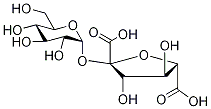
What is Sucrose 1’6’Dicarboxylic Acid?
The Uses of Sucrose 1’6’Dicarboxylic Acid
Sucrose 1’6’Dicarboxylic Acid is used in the manufacture of sucrose carboxylic acid derivatives as antioxidants for the use of prevention of life style-related disease.
The Uses of Sucrose 1’6’Dicarboxylic Acid
Sucrose 1’,6’-Dicarboxylic Acid is used in the manufacture of sucrose carboxylic acid derivatives as antioxidants for the use of prevention of life style-related disease.
Safety information for Sucrose 1’6’Dicarboxylic Acid
New Products
Dibenzoyl-L-tartaric acid Anhydrous (Resolution Reagent) 2-Bromo-5-hydroxybenzoic acid. 1-(4-methoxyphenyl)-4-(4-Nitrophenyl)Piperazine (IT-1) 4-Fluorophenylglycine 1-N-Boc-3-(aminoethyl)azetidine Dimedone 1-Boc-3-(cyanomethyl)azetidine N-BOC-piperidine-4-carboxylic acid 1-Benzhydrylazetane-3-carbonitrile 5-Amino-2-Hydroxypyridine 2-Amino-5-Iodopyridine 2-BROMOACETYL BROMIDE-D2 METHANE SULFONIC ACID-D4 PHOSPORIC ACID-D3 85 W% IN D2O DEUTERIUM OXIDE FOR NMR BENZENE-D6 TOLUENE-D3 6-Chloro-pyrimidine-2,4-diamine 3-Oxide 1-Acetyl-4-(4-hydroxyphenyl)piperazine 1-(3-Chlorophenyl)piperazine hydrochlorideYou may like
-
 350-03-8 3-AcetylpyridineView Details
350-03-8 -
1-(4-Aminophenyl)-4-(4-methoxyphenyl)Piperazine 74852-62-3View Details
74852-62-3 -
556-08-1 4-Acetamidobenzoic acidView Details
556-08-1 -
5-Bromo-2-Chlorobenzoic acid 21739-92-4View Details
21739-92-4 -
15128-52-6View Details
15128-52-6 -
36476-86-5 1-Benzhydrylazetane-3-carbonitrile 98+View Details
36476-86-5 -
36476-86-5 1-Benzhydrylazetane-3-carbonitrile 98+View Details
36476-86-5 -
36476-86-5 1-Benzhydrylazetane-3-carbonitrile 98+View Details
36476-86-5
Statement: All products displayed on this website are only used for non medical purposes such as industrial applications or scientific research, and cannot be used for clinical diagnosis or treatment of humans or animals. They are not medicinal or edible.