
STEVIA
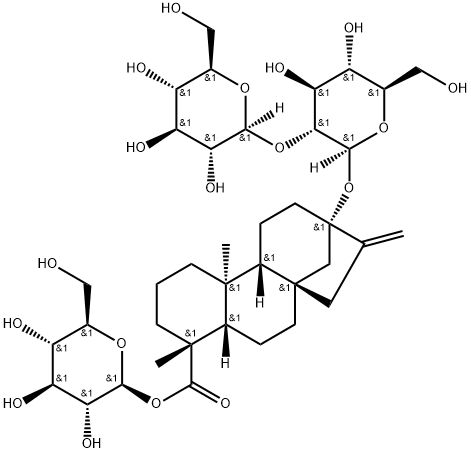
- Empirical Formula: C38H60O18
- Molecular Weight: 0
- MDL number: MFCD00132380
- EINECS: 1592732-453-0
- Update Date: 2023-09-11 17:45:53
What is STEVIA?
Chemical properties
sweet powder
The Uses of STEVIA
Stevia is the plant stevia rebaudiana bertoni whose leaves provide ste- viol glycosides, the compounds responsible for the sweet taste of the leaves. it sometimes refers to the sweetener component. see steviol glycosides.
Agricultural Uses
Stevia (Stevia rebaudiana) is a perennial, semi-bushy plant
which originated in Paraguay. It is robust in nature and is
tolerant to a range of climatic and soil conditions. For its
growth, the temperature should ideally be between 15°C
and30°C, and the pH range between 6.5 and 7.9. It grows
to a height of around a meter and bears white flowers.
Cultivated stevia needs regular irrigation and fertilization.
The leaves of stevia produce an extract called
stevioside, which contains crystalline diterpens
glycosides. Stevioside is a non-caloric, non-fermentable,
non-discoloring natural sweetener. It is more than 200
times sweeter than sucrose. The leaves are ready for
collection about 4 months after transplanting. The
quantity and quality of stevioside is best just prior to
flowering. In addition, the leaves have been tested to
contain Vitamin C, beta carotine and fiber. Once the
plant matures, the leaves can be plucked every month.
Stevia is prescribed in diets tailored for diabetics and
over-weight patients.
The plant is best propagated by cuttings which
become ready for transplanting in 1% months.
Transplantation may be done in mid-May, maintaining
row spaces of 50 to 60 cm., thus accommodating around
100,000 plants per hectare. The leaf yields can go up to 3
tons/ha with a stevioside content of about 15%.
Drying, threshing and packaging of stevia leaves
render them a long shelf life. The leaves are increasingly
used in cooked/baked products, processed foods and
beverages. With the US FDA allowing the use of this
natural product in the production of processed foods
(1995), it is likely that the production and use of this plant
will get a boost.
Safety information for STEVIA
New Products
9-Mesityl-10-methylacridinium perchlorate Sulfapyridine Fmoc-OSu (R)-(-)-2-Amino-1-propanol Cyclobutanone 5-bromo-4-fluoro-2-nitrobenzaldehyde 4 pentyn 1 ol N-Vinylformamide Phenethyl cinnamate Pyrrolo[1,2-a]pyrimidine-6-carboxylic acid, 4,6,7,8-tetrahydro-4-oxo-, sodium salt (1:1), (6S) Ethyl 3-phenylpropanoate β-Bromostyrene Methacrylate-PEG-Methacrylate, Mn:35000 2,4-Dihydroxyacetophenone 2-Chloro 5-Fluoro Pyridine Vasicinone 2-Chloroisonicotinic Acid Tween 80 or Polysorbate 80 5-Bromo-1-Pentyne 1-(2-Methyl-5-nitrophenyl)guanidine Nitrate Methyl trans-4-Aminocyclohexanecarboxylate Hydrochloride 2-Pentyn-1-oL 4-Nitrobenzotrifluoride N-(4-Cyano-3-(trifluoromethyl)phenyl)-2-methyloxirane-2-carboxamideRelated products of tetrahydrofuran


You may like
-
 Stevia Extract 99%View Details
 -
Stevia rebaudiana bertoni leaves CASView Details
-
Fmoc-OSu 98+View Details
82911-69-1 -
(R)-(-)-2-Amino-1-propanol 35320-23-1 98+View Details
35320-23-1 -
1191-95-3 Cyclobutanone 98+View Details
1191-95-3 -
213382-45-7 98+View Details
213382-45-7 -
Fmoc-OSu 98+View Details
82911-69-1 -
(R)-(-)-2-Amino-1-propanol 35320-23-1 98+View Details
35320-23-1