
StaupriMide
Synonym(s):ESC EMT Inducer, Spd;N-Benzoyl-7-oxo Staurosporine;Stauprimide - CAS 154589-96-5 - Calbiochem
- CAS NO.:154589-96-5
- Empirical Formula: C35H28N4O5
- Molecular Weight: 584.62
- MDL number: MFCD14635443
- SAFETY DATA SHEET (SDS)
- Update Date: 2026-04-21 10:31:43
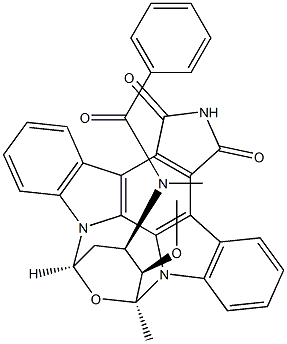
What is StaupriMide?
Description
Stauprimide is a small molecule that increases the efficiency of mouse and human embryonic stem cell differentiation in conjunction with lineage specification cues (EC50 = 0.3 μM). It specifically inhibits the nuclear localization of NME2, which results in the suppression of c-
The Uses of StaupriMide
Labelled Stauprimide (S684700). It is an enhancer stem cell differentiation into endoderm.
The Uses of StaupriMide
Stauprimide is an enhancer stem cell differentiation into endoderm. In vitro differentiation of embryonic stem cells is of great interest to regenerative medicine, and current protocols are labor-intensive and expensive. Small molecules that induce or enhance differentiation are highly desired. High-content screening identified compounds that enhance endodermal differentiation in the presence of low levels of Activin A. Stauprimide increased definitive endodermal markers but not markers for visceral/parietal endoderm or mesoderm. Stauprimide-differentiated cells could be further differentiated into hepatocytes. Stauprimide treatment during differentiation decreased the concentration of Activin A required for definitive endoderm formation, and it eliminated the need for serum. The mechanism of action of stauprimide is to sensitize cells for differentiation. Stauprimide enabled differentiation into other cell lineages under varying differentiation conditions, including neurons, hematopoietic mesoderm, beating cardiac myocytes, and skeletal muscle.
The Uses of StaupriMide
Stauprimide is a semi-synthetic analogue of the staurosporine family of indolocarbazoles. Stauprimide was first published in 1994 as part of an extensive structure-activity investigation to improve the selective inhibition of protein kinase C as potential antitumour agents. Stauprimide increases the efficiency of the directed differentiation of mouse and human embryonic stem cells in synergy with defined extracellular signalling cues. Stauprimide interacts with NME2 (PUF) transcription factor to down-regulate c-Myc expression, leading to differentiation of stem cells.
What are the applications of Application
Stauprimide is an indolocarbazole promoter of embryonic stem cell differentiation
General Description
A cell-permeable ESCs (Embryonic Stem Cells) EMT (Epithelial-Mesenchymal Transition) inducer that is reported to prime/sensitize human and murine ESC cultures for much more enhanced/efficient differentiation into progenitor cells of multiple lineages, including Activin A- (Cat. No. 114700) induced definitive endoderm differentiation (60% differentiation from murine R1 ESCs with 5 ng/ml Activin A and 200 nM Spd), ATRA- (Cat. No. 554720) induced neuronal progenitor differentiation, and BMP-4- (Cat. No. 203642) induced mesoderm differentiation, under suboptimal lineage specifying stimuli concentrations and often serum-free conditions, while Spd sensitization alone does not induce any ESCs differentiation. Spd is shown to interact with NME2/DNPK B/PUF and prevent NME2 nuclear localization and c-myc transcription in murine R1 ESC cultures (46% and 85% drop in c-myc mRNA in 24 h, respectively, with 200 nM and 500 nM Spd), which accounts for, at least in part, its EMT induction activity. Although a structural analog of the broad-spectrum kinase inhibitors Staurosporine (Cat. Nos. 569396 and 569397) and UCN-01 (Cat. No. 539644), Spd exhibits significant kinase inhibitory activities only at elevated concentrations, but not at concentrations ≤500 nM typically used in EMT induction.
Biochem/physiol Actions
Stauprimide is an enhancer stem cell differentiation into endoderm. In vitro differentiation of embryonic stem cells is of great interest to regenerative medicine, and current protocols are labor-intensive and expensive. Small molecules that induce or enhance differentiation are highly desired. High-content screening identified compounds that enhance endodermal differentiation in the presence of low levels of Activin A. Stauprimide increased definitive endodermal markers but not markers for visceral/parietal endoderm or mesoderm. Stauprimide-differentiated cells could be further differentiated into hepatocytes. Stauprimide treatment during differentiation decreased the concentration of Activin A required for definitive endoderm formation, and it eliminated the need for serum. The mechanism of action of stauprimide is to sensitize cells for differentiation. Stauprimide enabled differentiation into other cell lineages under varying differentiation conditions, including neurons, hematopoietic mesoderm, beating cardiac myocytes, and skeletal muscle. The cellular target of stauprimide was determined to be inhibition of NME2 transcription factor translocation to the nucleus, leading to down-regulation of c-Myc expression.
Storage
-20°C
References
1) Zhu et al. (2009), A small molecule primes embryonic stem cells for differentiation; Cell Stem Cell, 4 416 2) Zaret et al. (2009), Using small molecules to great effect in stem cell differentiation; Cell Stem Cell, 4 373 3) Bouvard et al. (2017) Small molecule selectively suppresses MYC transcription in cancer cells; Proc. Natl. Acad. Sci. USA 114 3497
Properties of StaupriMide
| Density | 1.52±0.1 g/cm3(Predicted) |
| storage temp. | -20°C |
| solubility | DMSO: >20mg/mL |
| pka | 9.51±0.70(Predicted) |
| form | Yellow solid |
| color | white to beige |
| Stability: | Stable for 2 years from date of purchase as supplied. Solutions in DMSO may be stored at -20°C for up to 2 months. |
Safety information for StaupriMide
| Signal word | Warning |
| Pictogram(s) |
 Exclamation Mark Irritant GHS07 |
| GHS Hazard Statements |
H315:Skin corrosion/irritation H319:Serious eye damage/eye irritation H335:Specific target organ toxicity, single exposure;Respiratory tract irritation |
| Precautionary Statement Codes |
P261:Avoid breathing dust/fume/gas/mist/vapours/spray. P271:Use only outdoors or in a well-ventilated area. P280:Wear protective gloves/protective clothing/eye protection/face protection. |
Computed Descriptors for StaupriMide
New Products
2-Ethoxyphenol Methyl 2-methoxy-5-sulfamoylbenzoate Ethyl 2-chloro-2-(2-(4-methoxyphenyl)hydrazono)acetate 3,6-Dichloropyridazine 3,6-Dichloro-4-Isopropylpyridazine 2-[(2-Ethoxyphenoxy)methyl]oxirane m-Tolualdehyde p-Anisaldehyde 2-Bromobenzaldehyde 4-Fluorobenzaldehyde 1-Propyl-4-piperidone 3-Amino-3-(3-fluorophenyl)propanoic acid 6-Methyl-2-pyridinemethanol 2-Pyridinecarboxaldehdye tert-Butyl ((1R,2S,5S)-2-amino-5-(dimethylcarbamoyl)cyclohexyl)carbamate 1-Indanone 2-Chloromethyl-6-methyl-pyridine 4-Morpholinoaniline Abiraterone Ethyl Ether 1-nitro-3,5-dimethyl adamantine (NMEM) Vardenafil Bis-sulphonamide(Dimer) 3-(2-aminoethyl) benzene sulfonamide Nabumetone Impurity 5 2,2-dibromo-1-cyclopropyl-2-(2-fluorophenyl)ethan-1-oneRelated products of tetrahydrofuran

You may like
-
 Stauprimide CAS 154589-96-5View Details
154589-96-5 -
Stauprimide CAS 154589-96-5View Details
154589-96-5 -
3-(4-Bromo-3-methyl-2-oxo-2,3-dihydro-1h-benzo[d]imidazol-1-yl)piperidine-2,6-dione 2304754-51-4 99%+View Details
2304754-51-4 -
1126-74-5 99%+View Details
1126-74-5 -
2-Fluoro-6-iodobenzoic acid 99%+View Details
111771-08-5 -
120013-39-0 2,3-Dihydro-5,6-dimethoxy-2-(4-piperidinylmethyl)-1H-inden-1-one hydrochloride 99%+View Details
120013-39-0 -
ethyl 2-oxo-2,3,9,10-tetrahydro-1H-pyrido[3',4':4,5]pyrrolo[1,2,3-de]quinoxaline-8(7H)-carboxylate 313544-31-9 99%+View Details
313544-31-9 -
1-Boc-4-cyanopiperidine 91419-52-2 99%+View Details
91419-52-2