
SILICATE
- Empirical Formula: O3Si-2
- Molecular Weight: 76.0837
- Update Date: 2023-02-15 16:18:19
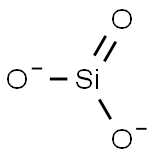
What is SILICATE?
The Uses of SILICATE
Fillers in plastics and rubber, paper coatings, antacids, anticaking agents, cements.
Definition
Any of the widely occurring compounds containing silicon, oxygen, and one or more metals with or without hydrogen. The silicon and oxygen may combine with organic groups to form silicate esters. Most rocks (except limestone and dolomite) and many mineral
Definition
silicate: Any of a group of substancescontaining negative ionscomposed of silicon and oxygen. Thesilicates are a very extensive groupand natural silicates form the majorcomponent of most rocks (see silicateminerals). The basic structural unit is the tetrahedral SiO4 group. This may occur as a simple discrete SiO44– anion as in the orthosilicates, e.g. phenacite (Be2SiO4) and willemite (Zn2SiO4). Many larger silicate species are also found (see illustration). These are composed of SiO4 tetrahedra linked by sharing oxygen atoms as in the pyrosilicates, Si2O76–, e.g. Sc2Si2O7. The linking can extend to such forms as bentonite, BaTiSi3O9, or alternatively inÜnite chain anions, which are single strand (pyroxenes) or double strand (amphiboles). Spodumene, LiAl(SiO3)2, is a pyroxene and the asbestos minerals are amphiboles. Large two-dimensional sheets are also possible, as in the various micas (see illustration), and the linking can extend to full threedimensional framework structures, often with substituted trivalent atoms in the lattice. The zeolites are examples of this.
Hazard
(Natural silicate dusts) Toxic by inhalation.
Agricultural Uses
Any of the widely occurring compounds containing
silicon, oxygen and one or more metals with or without
hydrogen is called silicate. The silicon and oxygen may
combine with organic groups to form similar esters. Most
rocks and many minerals, except limestone and dolomite,
are silicates. Typical natural silicates are gemstones,
except for diamond. Portland cement, because it is
manufactured from chalk and clay, contains a high
percentage of calcium silicates.
Sodium silicate is the best known of the synthetic
silicates.
Safety information for SILICATE
New Products
2-Bromo-4-hydroxypyridine Dibenzoyl-L-tartaric acid Anhydrous (Resolution Reagent) Dibenzo[b,f][1,4]thiazepin-11(10H)-one 1,2,3,9-Tetrahydro-9-Methyl-4H-Carbazole-4-One Cis-Tosylate 1-(4-methoxyphenyl)-4-(4-Nitrophenyl)Piperazine (IT-1) 2'-Fluoroacetophenone 1-aminocyclobutanecarbonitrile hydrochloride AMINO-O-TOLYL-ACETIC ACID N-Methyl-2-amino-2-methylpropionamide 4-(FMOC-AMINO)-TETRAHYDROPYRAN-4-CARBOXYLIC ACID 1-Aminocyclobutanecarboxylic Acid Hydrochloride METHANOL-D1(OD) TERTIARY BUTANOL-D9 N-ETHYL-D5-AMINE HYDROCHLORIDE BENZOIC ACID-D CHLOROFORM-D TOLUENE-D3 2-(2-Bromophenyl)ethanol Boc-D-Glu(OMe)-OMe 2,5 Dibromopyridine Ethyl 4-hydroxy-3-oxobutanoate Dimethyl (2S)-2-((tert-butoxycarbonyl)amino)-4-(cyanomethyl)pentanedioate 1-(3-Chlorophenyl)piperazine hydrochlorideYou may like
-
 98071-16-0 1-Aminocyclobutanecarboxylic Acid Hydrochloride 98+View Details
98071-16-0 -
106914-07-2 N-Methyl-2-amino-2-methylpropionamide 98+View Details
106914-07-2 -
129592-98-9 98+View Details
129592-98-9 -
4-(FMOC-AMINO)-TETRAHYDROPYRAN-4-CARBOXYLIC ACID 98+View Details
285996-72-7 -
1-aminocyclobutanecarbonitrile hydrochloride 845821-84-3 98+View Details
845821-84-3 -
98071-16-0 1-Aminocyclobutanecarboxylic Acid Hydrochloride 98+View Details
98071-16-0 -
 ADC-151View Details
27176-87-0 -
 Nickel Acetate | Eastmen Chemicals - Manufacturer, Supplier, Exporter metallic saltsView Details