
SGI-1027
Synonym(s):N-(4-(2-Amino-6-methylpyrimidin-4-ylamino)phenyl)-4-(quinolin-4-ylamino) benzamide
- CAS NO.:1020149-73-8
- Empirical Formula: C27H23N7O
- Molecular Weight: 461.52
- MDL number: MFCD27937047
- SAFETY DATA SHEET (SDS)
- Update Date: 2026-07-14 16:49:18
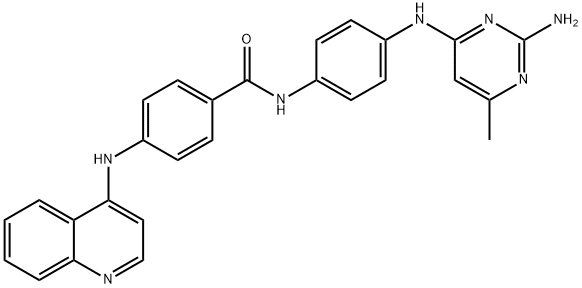
What is SGI-1027?
Description
SGI-1027 (1020149-73-8) is a potent and selective inhibitor of DNA methyl transferase inhibiting DNMT1, DNMT3A and DNMT3B with comparable potency (IC50=12.5, 8.0 and 7.5 mM respectively).1? Treatment of various cancer cell lines with SGI-1027 results in selective degradation of DNMT1 (MG-132 sensitive) with minimal effect on DNMT3A and 3B at 2.5-5 mM.1 Prolonged treatment of RKO cells resulted in reexpression of silenced tumor suppressor genes.1 Synergizes with doxorubicin at growth inhibition in neuroblastoma cell lines.2 Disrupts the MKK3-MYC complex in cells and inhibits MYC transcriptional activity in colon and breast cancer cells.3
The Uses of SGI-1027
SGI-1027 is a quinoline derivative and a potent inhibitor of DNA methyltransferase (DNMT). SGI-1027 can be used as a potential therapeutic agent for the treatment of cancer and other diseases and also as a research tool to investigate the role of DNMTs in epigenetic events.
What are the applications of Application
SGI-1027 is an inhibitor of the DNA methyltransferases
Biochem/physiol Actions
SGI-1027 is a DNA methyltransferase (DNMT) inhibitor with IC50 values of 6-13 μM for DNMT3B, DNMT3A and DNMT1. SGI-1027 directly inhibits DNMT activity by competing with the cofactor, S-adenosylmethionine (SAM) in the methylation reaction. SGI-1027 treatment of cancer cell lines induced degradation of DNMT1, but not DNMT3A or DNMT3B, and in RKO cells caused re-expression of the silenced tumor supressor genes p16, MLH1 and TIMP3.
Storage
Store at -20°C
References
Datta et al. (2009), A new class of quinoline-based DNA hypomethylating agents reactivates tumor suppressor genes by blocking DNA methyltransferase 1 activity and inducing its degradation; Cancer Res., 69 4277 Penter et al. (2015) A rapid screening system evaluates novel inhibitors of DNA methylation and suggests F-box proteins as potential therapeutic targets for high-risk neuroblastoma; Target Oncol., 10 523 Yang et al. (2021), Discovery of the first chemical tools to regulate MKK3-mediated MYC activation in cancer; Bioorg. Chem., 45 116324
Properties of SGI-1027
| Melting point: | >280℃ |
| Density | 1.387±0.06 g/cm3(Predicted) |
| storage temp. | 2-8°C |
| solubility | Soluble in DMSO (up to 35 mg/ml) |
| pka | 13.31±0.70(Predicted) |
| form | powder |
| color | white to light brown |
| Stability: | Stable for 2 years as supplied. Solutions in DMSO may be stored at -20°C for up to 3 months. |
Safety information for SGI-1027
Computed Descriptors for SGI-1027
New Products
Cis-Tosylate Dibenzo[b,f][1,4]thiazepin-11(10H)-one 1,2,3,9-Tetrahydro-9-Methyl-4H-Carbazole-4-One Dibenzoyl-L-tartaric acid Anhydrous (Resolution Reagent) N-BOC-piperidine-4-carboxylic acid 1-Benzhydrylazetane-3-carbonitrile AMINO-(3-CHLORO-PHENYL)-ACETIC ACID 2-(2-Chlorophenyl)glycine (±)-amino(2-fluorophenyl)acetic acid 8-oxa-1,3-diazaspiro[4.5]decane-2,4-dione BENZOIC ACID-D5 TRIFLOURO ACETICACID-D METHANE SULFONIC ACID-D4 PHOSPORIC ACID-D3 85 W% IN D2O TOLUENE-D3 BENZENE-D6 1-Acetyl-4-(4-hydroxyphenyl)piperazine 1-(3-Chlorophenyl)piperazine hydrochlorideRelated products of tetrahydrofuran
You may like
-
 SGI-1027 CAS 1020149-73-8View Details
1020149-73-8 -
7292-71-9 AMINO-(3-CHLORO-PHENYL)-ACETIC ACID 98+View Details
7292-71-9 -
84145-28-8 98+View Details
84145-28-8 -
2-(2-Chlorophenyl)glycine 98+View Details
88744-36-9 -
7292-71-9 AMINO-(3-CHLORO-PHENYL)-ACETIC ACID 98+View Details
7292-71-9 -
84145-28-8 98+View Details
84145-28-8 -
2-(2-Chlorophenyl)glycine 98+View Details
88744-36-9 -
8-oxa-1,3-diazaspiro[4.5]decane-2,4-dione 39124-19-1 98+View Details
39124-19-1