
(S)-(-)-1-Phenylethyl isocyanate
Synonym(s):(S)-(−)-1-Phenylethyl isocyanate
- CAS NO.:14649-03-7
- Empirical Formula: C9H9NO
- Molecular Weight: 147.17
- MDL number: MFCD00002036
- EINECS: 238-698-6
- SAFETY DATA SHEET (SDS)
- Update Date: 2026-05-28 04:11:06
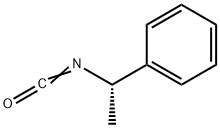
What is (S)-(-)-1-Phenylethyl isocyanate?
Chemical properties
Colorless to light yellow liqui
The Uses of (S)-(-)-1-Phenylethyl isocyanate
(S)-(-)-1-Phenylethyl isocyanate act by inhibition of cell proliferation and induction of apoptosis. It helps to prevent lung cancer and esophageal cancer. It is a fine chemical intermediate.
General Description
(S)-(-)-α-Methylbenzyl isocyanate is a commonly used chiral derivatizing agent for the resolution of enantiomers.
Purification Methods
Purify the isocyanates by fractional distillation under a vacuum. With ammonia
Properties of (S)-(-)-1-Phenylethyl isocyanate
| Melting point: | 65 °C |
| alpha | -10 º (NEAT) |
| Boiling point: | 55-56 °C2.5 mm Hg(lit.) |
| Density | 1.045 g/mL at 20 °C(lit.) |
| refractive index | n |
| Flash point: | 150 °F |
| storage temp. | 2-8°C |
| form | Liquid |
| color | Clear colorless to pale yellow |
| optical activity | [α]20/D 10°, neat |
| Water Solubility | Decomposition |
| Sensitive | Moisture Sensitive |
| BRN | 4230972 |
| CAS DataBase Reference | 14649-03-7(CAS DataBase Reference) |
Safety information for (S)-(-)-1-Phenylethyl isocyanate
| Signal word | Danger |
| Pictogram(s) |
 Skull and Crossbones Acute Toxicity GHS06  Health Hazard GHS08 |
| GHS Hazard Statements |
H315:Skin corrosion/irritation H317:Sensitisation, Skin H319:Serious eye damage/eye irritation H330:Acute toxicity,inhalation H334:Sensitisation, respiratory H335:Specific target organ toxicity, single exposure;Respiratory tract irritation H412:Hazardous to the aquatic environment, long-term hazard |
| Precautionary Statement Codes |
P260:Do not breathe dust/fume/gas/mist/vapours/spray. P273:Avoid release to the environment. P280:Wear protective gloves/protective clothing/eye protection/face protection. P302+P352:IF ON SKIN: wash with plenty of soap and water. P305+P351+P338:IF IN EYES: Rinse cautiously with water for several minutes. Remove contact lenses, if present and easy to do. Continuerinsing. |
Computed Descriptors for (S)-(-)-1-Phenylethyl isocyanate
| InChIKey | JJSCUXAFAJEQGB-QMMMGPOBSA-N |
(S)-(-)-1-Phenylethyl isocyanate manufacturer
ASM Organics
Andhra Pradesh
Phone:91-9866122393
Whatsapp: 91-9866122393
product: (S)-(-)-1-Phenylethyl isocyanate
New Products
5-bromo-4-fluoro-2-nitrobenzaldehyde (R)-(-)-2-Amino-1-propanol Cyclobutanone Fmoc-OSu 1-(2-Chloroethyl)pyrrolidine Hydrochloride 2-Amino-2-(4-methylphenyl)acetic acid β-Bromostyrene Ethyl 3-phenylpropanoate Phenethyl cinnamate Dipropyl disulfide 4 pentyn 1 ol N-Vinylformamide Methacrylate-PEG-Methacrylate, Mn:35000 2,4-Dihydroxyacetophenone 2-Chloro 5-Fluoro Pyridine Vasicinone 2-Chloroisonicotinic Acid Tween 80 or Polysorbate 80 2-Butyn-1-oL 2-Pentyn-1-oL 4-Nitrobenzotrifluoride N-(4-fluoro-2-methoxy-5-nitrophenyl)-4-(1-methyl-1H-indol-3-yl)pyrimidin-2-amine Pirtobrutinib intd. N-(4-Cyano-3-(trifluoromethyl)phenyl)-2-methyloxirane-2-carboxamideRelated products of tetrahydrofuran

You may like
-
 14649-03-7 (S)-(-)-1-Phenylethyl isocyanate-98% 99%View Details
14649-03-7 -
 (S)-(-)-1-Phenylethyl isocyanate 98%View Details
14649-03-7 -
 (S)-(-)-1-Phenylethyl isocyanate CAS 14649-03-7View Details
14649-03-7 -
(S)-(-)-α-Methylbenzyl Isocyanate CAS 14649-03-7View Details
14649-03-7 -
(S)-(−)-α-Methylbenzyl isocyanate CAS 14649-03-7View Details
14649-03-7 -
(S)-(−)-α-Methylbenzyl isocyanate CAS 14649-03-7View Details
14649-03-7 -
14649-03-7 97-99 %View Details
14649-03-7 -
7250-67-1 1-(2-Chloroethyl)pyrrolidine Hydrochloride 98+View Details
7250-67-1
Statement: All products displayed on this website are only used for non medical purposes such as industrial applications or scientific research, and cannot be used for clinical diagnosis or treatment of humans or animals. They are not medicinal or edible.