
Rimonabant hydrochloride
Synonym(s):5-(4-Chlorophenyl)-1-(2,4-dichlorophenyl)-4-methyl-N-1-piperidinyl-1H-pyrazole-3-carboxamide hydrochloride;SR141716;SR-141716;SR141716A;SR-141716A
- CAS NO.:158681-13-1
- Empirical Formula: C22H21Cl3N4O.ClH
- Molecular Weight: 500.25
- MDL number: MFCD00934884
- EINECS: 233-720-0
- SAFETY DATA SHEET (SDS)
- Update Date: 2026-05-28 02:30:14
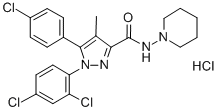
What is Rimonabant hydrochloride?
Chemical properties
White to Off-White Crystalline Solid
The Uses of Rimonabant hydrochloride
Rimonabant hydrochloride has been used as an antagonist of cannabinoid 1 (CB1) receptor:
- to study its effects on protein synthesis in C2C12 myotubes
- to analyze its effects on human astroglia
- in combination with methanandamide (mAEA) to study its effects on murine gastric vagal afferent mechanosensitivity
The Uses of Rimonabant hydrochloride
The first of a new class of selective (Cannabinoid-1 (CB-1) receptor antagonists
The Uses of Rimonabant hydrochloride
A brain cannabinoid receptor (CB1) antagonist. Antiobesity agent.
What are the applications of Application
Rimonabant Hydrochloride is a CB1 (cannabinoid receptor 1) antagonist
Hazard
A poison.
Biochem/physiol Actions
Rimonabant acts as a mycobacterial membrane protein large 3 (MMPL3) inhibitor. Rimonabant hydrochloride exhibits therapeutic activity against weight reduction and smoking cessation.
Storage
Desiccate at RT
Properties of Rimonabant hydrochloride
| Melting point: | 230-240°C |
| storage temp. | 2-8°C |
| solubility | DMSO: soluble20mg/mL, clear |
| form | powder |
| color | white to beige |
| CAS DataBase Reference | 158681-13-1(CAS DataBase Reference) |
Safety information for Rimonabant hydrochloride
| Signal word | Danger |
| Pictogram(s) |
 Skull and Crossbones Acute Toxicity GHS06 |
| GHS Hazard Statements |
H301:Acute toxicity,oral H319:Serious eye damage/eye irritation |
| Precautionary Statement Codes |
P305+P351+P338:IF IN EYES: Rinse cautiously with water for several minutes. Remove contact lenses, if present and easy to do. Continuerinsing. |
Computed Descriptors for Rimonabant hydrochloride
New Products
2-(2-Chlorophenyl)glycine Propiolic Acid 1-(3-Hydroxy-4-methoxyphenyl)-2-nitroethene (±)-amino(2-fluorophenyl)acetic acid trans-3-Benzyloxy-4-methoxy-beta-nitrostyrene 1-Pentadecanol 4-(4-Αminophenyl)-3-Morpholinone 3-Morpholino-1-(4-(2-oxopiperidin-1-yl) phenyl)-5,6-dihyropyridin-2-(1H)-one 1-(4-Aminophenyl)-3-morpholino-5,6-dihydropyridin-2(1H)-one N-cyanoacetylurethane 1H-IndazoleRelated products of tetrahydrofuran
You may like
-
 Rimonabant HCl 96% CAS 158681-13-1View Details
158681-13-1 -
Rimonabant hydrochloride CAS 158681-13-1View Details
158681-13-1 -
471-25-0 Propiolic Acid 98+View Details
471-25-0 -
84145-28-8 98+View Details
84145-28-8 -
trans-3-Benzyloxy-4-methoxy-beta-nitrostyrene 98+View Details
63909-29-5 -
2-(2-Chlorophenyl)glycine 88744-36-9 98+View Details
88744-36-9 -
40216-83-9 trans-4-Hydroxy-L-proline methyl ester hydrochloride 98+View Details
40216-83-9 -
1-(3-Hydroxy-4-methoxyphenyl)-2-nitroethene 98+View Details
39816-35-8
Statement: All products displayed on this website are only used for non medical purposes such as industrial applications or scientific research, and cannot be used for clinical diagnosis or treatment of humans or animals. They are not medicinal or edible.