
riddelline
- CAS NO.:23246-96-0
- Empirical Formula: C18H23NO6
- Molecular Weight: 349.38
- MDL number: MFCD01684623
- SAFETY DATA SHEET (SDS)
- Update Date: 2026-04-24 14:59:10
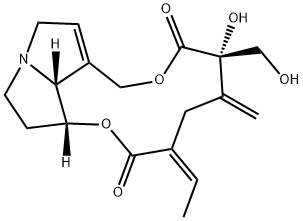
What is riddelline?
Chemical properties
Colorless to yellowish crystalline solid. Starts turning brown at approximately 165℃; turns blackish- brown at 187℃.
The Uses of riddelline
Riddelliine-containing plants are not used for food in the United States, and riddelliine and riddelliine N-oxide have no known commercial uses. However, the riddelliine-containing plant Senecio longilobus has been used in medicinal herb preparations in the United States, and S. jacobaea and S. vulgaris, both of which have been shown to contain riddelliine, are used in medicinal preparations in other parts of the world (Mattocks 1986).
Definition
ChEBI: A macrolide that is 13,19-didehydrosenecionan bearing two additional hydroxy substituents at positions 12 and 18 as well as two additional oxo groups at positions 11 and 16.
General Description
Colorless to off-white crystalline solid. Starts turning brown at approximately 329°F; is blackish-brown at melting point.
Air & Water Reactions
Exposure to light and air can cause gradual oxidation. Insoluble in water.
Reactivity Profile
riddelline reacts readily with oxidizing agents (slowly with atmospheric oxygen). On contact with bases, hydrolysis will probably occur .
Fire Hazard
Flash point data for riddelline are not available; however, riddelline is probably combustible.
Potential Exposure
Riddelline is a natural alkaloid product used a laboratory chemical and reference standard.
Carcinogenicity
Riddelliine is reasonably anticipated to be a human carcinogen based on sufficient evidence of carcinogenicity from studies in experimental animals and supporting data from studies on mechanisms of carcinogenesis.
Shipping
UN1544 Alkaloids, solid, n.o.s. or Alkaloid salts, solid, n.o.s. poisonous, Hazard Class: 6.1; Labels: 6.1-Poisonous materials, Technical Name Required.
Incompatibilities
Riddelline is sensitive to light, air, and heat, causing oxidation; reacts slowly with atmospheric oxygen. This chemical is probably combustible; dust mixed with air may be explosive. Incompatible with oxidizers (chlorates, nitrates, peroxides, permanganates, perchlorates, chlorine, bromine, fluorine, etc.); contact may cause fires or explosions. Keep away from alkaline materials, strong bases, strong acids, oxoacids, and epoxides. Contact with alkalis and bases may cause hydrolysis.
Waste Disposal
It is inappropriate and possi- bly dangerous to the environment to dispose of expired or waste product such as lab chemicals by flushing them down the toilet or discarding them to the trash. Larger quantities shall carefully take into consideration applicable EPA, and FDA regulations. If possible return the lab che- micals to the manufacturer for proper disposal being careful to properly label and securely package the material. Alternatively, the waste lab chemicals shall be labeled, securely packaged and transported by a state licensed medi- cal waste contractor to dispose by burial in a licensed haz- ardous or toxic waste landfill or incinerator.
Properties of riddelline
| Melting point: | 197.5°C (rough estimate) |
| Boiling point: | 483.56°C (rough estimate) |
| Density | 1.2966 (rough estimate) |
| refractive index | 1.5740 (estimate) |
| pka | 11.62±0.20(Predicted) |
| IARC | 2B (Vol. 10, Sup 7, 82) 2002 |
| EPA Substance Registry System | Riddelline (23246-96-0) |
Safety information for riddelline
Computed Descriptors for riddelline
New Products
Dibenzoyl-L-tartaric acid Anhydrous (Resolution Reagent) Cis-Tosylate Dibenzo[b,f][1,4]thiazepin-11(10H)-one 1,2,3,9-Tetrahydro-9-Methyl-4H-Carbazole-4-One 1-(4-methoxyphenyl)-4-(4-Nitrophenyl)Piperazine (IT-1) BOC Piperazine 1-Benzhydrylazetane-3-carbonitrile 8-oxa-1,3-diazaspiro[4.5]decane-2,4-dione (±)-amino(2-fluorophenyl)acetic acid 2-(2-Chlorophenyl)glycine AMINO-(3-CHLORO-PHENYL)-ACETIC ACID 2'-Fluoroacetophenone METHANOL-D1(OD) TERTIARY BUTANOL-D9 N-ETHYL-D5-AMINE HYDROCHLORIDE BENZOIC ACID-D CHLOROFORM-D TOLUENE-D3 Trans,trans muconic acid HC Blue-16 4-Amino-2-chloro-6,7-dimethoxyquinazoline Ethyl 4,5-bis(2-methoxyethoxy)-2-nitrobenzoate 2,3-Dimethoxypyridine 1-(3-Chlorophenyl)piperazine hydrochlorideRelated products of tetrahydrofuran

You may like
-
 Product IntroductionView Details
 -
 Product InrtroductionView Details
 -
 DGO24View Details
 -
 DGO25View Details
 -
 DGO29View Details
 -
 DGO32View Details
 -
 DGO36View Details
 -
 DGO37View Details