
Rhod-2 (potassium salt)
- CAS NO.:663625-18-1
- Empirical Formula: C40H39K3N4O11
- Molecular Weight: 869.05276
- Update Date: 2026-04-21 10:31:43
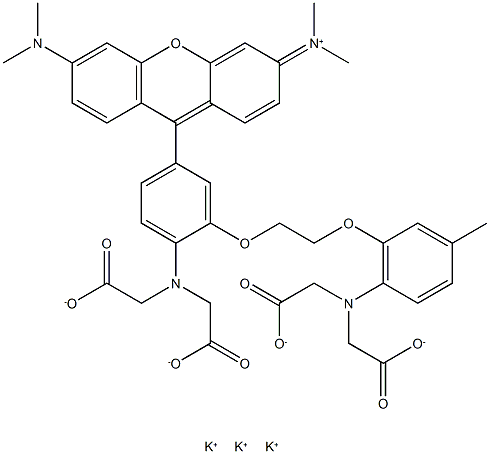
What is Rhod-2 (potassium salt)?
Description
Rhod-2 (potassium salt) is a water-soluble, red fluorescent calcium indicator. It exhibits a significant shift in fluorescence intensity upon calcium binding (ex max = 549 nm; calcium-free v. ex/em max = 552/581 nm; calcium-bound).1,2 Unlike the UV-excitable indicators fura-2 and indo-1 , there is no accompanying spectral shift.
References
1. Paredes, R.M., Etzler, J.C., Watts, L.T., et al. Chemical calcium indicators Methods 46(3),143-151(2008).
2. Minta, A., Kao, J.P., and Tsien, R.Y. Fluorescent indicators for cytosolic calcium based on rhodamine and fluorescein chromophores J. Biol. Chem. 264(14),8171-8178(1989).
Properties of Rhod-2 (potassium salt)
| storage temp. | Store at -20°C |
| solubility | DMSO: soluble; Water: soluble |
| form | A solid |
Safety information for Rhod-2 (potassium salt)
Computed Descriptors for Rhod-2 (potassium salt)
New Products
Dibenzoyl-L-tartaric acid Anhydrous (Resolution Reagent) Cis-Tosylate Dibenzo[b,f][1,4]thiazepin-11(10H)-one 1,2,3,9-Tetrahydro-9-Methyl-4H-Carbazole-4-One 1-(4-methoxyphenyl)-4-(4-Nitrophenyl)Piperazine (IT-1) BOC Piperazine 1-Benzhydrylazetane-3-carbonitrile 8-oxa-1,3-diazaspiro[4.5]decane-2,4-dione (±)-amino(2-fluorophenyl)acetic acid 2-(2-Chlorophenyl)glycine AMINO-(3-CHLORO-PHENYL)-ACETIC ACID 2'-Fluoroacetophenone METHANOL-D1(OD) TERTIARY BUTANOL-D9 N-ETHYL-D5-AMINE HYDROCHLORIDE BENZOIC ACID-D CHLOROFORM-D TOLUENE-D3 Trans,trans muconic acid HC Blue-16 4-Amino-2-chloro-6,7-dimethoxyquinazoline Ethyl 4,5-bis(2-methoxyethoxy)-2-nitrobenzoate 2,3-Dimethoxypyridine 1-(3-Chlorophenyl)piperazine hydrochlorideYou may like
-
 Product IntroductionView Details
 -
 Product InrtroductionView Details
 -
 DGO24View Details
 -
 DGO25View Details
 -
 DGO29View Details
 -
 DGO32View Details
 -
 DGO36View Details
 -
 DGO37View Details
Statement: All products displayed on this website are only used for non medical purposes such as industrial applications or scientific research, and cannot be used for clinical diagnosis or treatment of humans or animals. They are not medicinal or edible.