
RESINIFERATOXIN
- CAS NO.:57444-62-9
- Empirical Formula: C37H40O9
- Molecular Weight: 628.71
- MDL number: MFCD00135927
- SAFETY DATA SHEET (SDS)
- Update Date: 2026-07-17 09:03:53
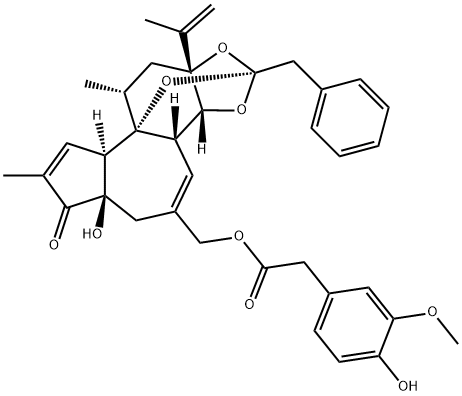
What is RESINIFERATOXIN?
Description
Resiniferatoxin (57444-62-9) is an ultrapotent TRPV1 activator (Ki=43 pM).1 Resiniferatoxin is 100-10,000 fold more potent than capsaicin for most responses yet displays a spectrum of activity distinct from capsaicin.2 A potent sensory neuron excitotoxin.3 Induces a long lasting analgesia in a rodent model of burn pain.4 SEVERE IRRITANT – HANDLE WITH CARE
Chemical properties
white to off-white solid
The Uses of RESINIFERATOXIN
Resiniferatoxin has been used as an agonist to transient receptor potential vanilloid 2 (TRPV2):
- for complex preparation for cryo-electron microscopy structural studies
- to test its effect towards immune responses to?P.?aeruginosa in sensory neurons associated with the cornea
- to study its effects in the denervation of the peripheral sensory nerves in psoriatic mice
Definition
ChEBI: Resiniferatoxin is a heteropentacyclic compound found in Euphorbia poissonii with molecular formula C37H40O9. It is an agonist of the transient receptor potential cation channel subfamily V member 1 (TrpV1). It has a role as a TRPV1 agonist, a plant metabolite, a neurotoxin and an analgesic. It is a diterpenoid, an ortho ester, a tertiary alpha-hydroxy ketone, a member of phenols, a monomethoxybenzene, an organic heteropentacyclic compound, a carboxylic ester and an enone.
Hazard
A poison.
Biological Activity
Ultrapotent analog of capsaicin that is an agonist at vanilloid receptors (K i = 43 pM). Like capsaicin, it acts as a selective modulator of primary afferent neurons. Also available as part of the Vanilloid TRPV1 Receptor Tocriset™ .
Biochem/physiol Actions
Resiniferatoxin (RTX) is an analog of capsaicin. It effectively ablates corneal sensory neurons by activating transient receptor potential vanilloid 1 (TRPV1) channels. RTX facilitates corneal bacterial clearance. It also elicits protective functionality towards cardiac function in a rat model with congestive heart failure (CHF).
References
1) Szolcsanyi et al. (1990), Resiniferatoxin: an ultrapotent selective modulator of capsaicin-sensitive primary afferent neurons; J. Pharmacol. Exp. Ther., 255 923 2) Szallasi and Blumberg (1998), Resiniferatoxin and its analogs provide novel insights into the pharmacology of the vanilloid (capsaicin) receptor; Life Sci. 47 1399 3) Winter et al. (1990) Cellular mechanism of action of resiniferatoxin: a potent sensory neuron excitotoxin; Brain Res. 520 131 4) Salas et al. (2017) Local Resiniferatoxin Induces Long-Lasting Analgesia in a Rat Model of Full Thickness Thermal Injury; Pain Med. 18 2453
Properties of RESINIFERATOXIN
| Boiling point: | 768.7±60.0 °C(Predicted) |
| Density | 1.35±0.1 g/cm3(Predicted) |
| storage temp. | -20°C |
| solubility | Soluble in DMSO to 100mM and to 50mM in ethanol |
| pka | 9.85±0.20(Predicted) |
| form | Solid |
| color | White to off-white |
| BRN | 5371150 |
| Stability: | Stable for 2 years from date of purchase as supplied. Solutions in DMSO or ethanol may be stored at -20°C for up to 1 month. |
Safety information for RESINIFERATOXIN
| Signal word | Danger |
| Pictogram(s) |
 Corrosion Corrosives GHS05  Skull and Crossbones Acute Toxicity GHS06 |
| GHS Hazard Statements |
H301:Acute toxicity,oral H314:Skin corrosion/irritation H315:Skin corrosion/irritation H319:Serious eye damage/eye irritation H335:Specific target organ toxicity, single exposure;Respiratory tract irritation |
| Precautionary Statement Codes |
P261:Avoid breathing dust/fume/gas/mist/vapours/spray. P280:Wear protective gloves/protective clothing/eye protection/face protection. P310:Immediately call a POISON CENTER or doctor/physician. P305+P351+P338:IF IN EYES: Rinse cautiously with water for several minutes. Remove contact lenses, if present and easy to do. Continuerinsing. P405:Store locked up. |
Computed Descriptors for RESINIFERATOXIN
New Products
2-Amino-5-bromo-4-(trifluoromethyl)pyridine Sulfapyridine Fmoc-OSu (R)-(-)-2-Amino-1-propanol Cyclobutanone 5-bromo-4-fluoro-2-nitrobenzaldehyde β-Bromostyrene Ethyl 3-phenylpropanoate Phenethyl cinnamate Dipropyl disulfide N-Vinylformamide 4 pentyn 1 ol Methacrylate-PEG-Methacrylate, Mn:35000 2,4-Dihydroxyacetophenone 2-Chloro 5-Fluoro Pyridine Vasicinone 2-Chloroisonicotinic Acid Tween 80 or Polysorbate 80 2-Butyn-1-oL 2-Pentyn-1-oL 4-Nitrobenzotrifluoride N-(4-fluoro-2-methoxy-5-nitrophenyl)-4-(1-methyl-1H-indol-3-yl)pyrimidin-2-amine Pirtobrutinib intd. N-(4-Cyano-3-(trifluoromethyl)phenyl)-2-methyloxirane-2-carboxamideRelated products of tetrahydrofuran

You may like
-
 1191-95-3 Cyclobutanone 98+View Details
1191-95-3 -
213382-45-7 98+View Details
213382-45-7 -
Fmoc-OSu 98+View Details
82911-69-1 -
(R)-(-)-2-Amino-1-propanol 35320-23-1 98+View Details
35320-23-1 -
1191-95-3 Cyclobutanone 98+View Details
1191-95-3 -
213382-45-7 98+View Details
213382-45-7 -
Fmoc-OSu 98+View Details
82911-69-1 -
(R)-(-)-2-Amino-1-propanol 35320-23-1 98+View Details
35320-23-1