
pyoluteorin
- CAS NO.:25683-07-2
- Empirical Formula: C11H7Cl2NO3
- Molecular Weight: 272.08
- MDL number: MFCD01716546
- SAFETY DATA SHEET (SDS)
- Update Date: 2026-02-02 18:10:39
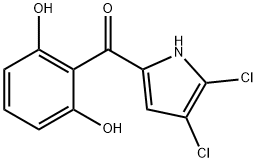
What is pyoluteorin?
The Uses of pyoluteorin
Pyoluteorin is a small chlorinated pyrrol produced by several species of Pseudomonas, first reported in 1958. Pyoluteorin exhibits a broad bioprofile, demonstrating antibiotic, antifungal and herbicidal activity. More recently, pyoluteorin has been investigated as bio-pesticide and has been shown to modulate the levels of metabolites in Pseudomonas.
What are the applications of Application
Pyoluteorin is a small chlorinated pyrrol with a broad bioprofile
Definition
ChEBI: Pyoluteorin is a member of the class of resorcinols that is resorcinol in which the hydrogen at position 2 is replaced by a 4,5-dichloro-1H-pyrrole-2-carbonyl group. It is a natural product found in Pseudomonas fluorescens which exhibits antibacterial properties and is a strong inducer of caspase-3-dependent apoptosis. It has a role as a bacterial metabolite, an apoptosis inducer, an antifungal agent, a marine metabolite and an antibacterial agent. It is a member of resorcinols, a member of pyrroles, an organochlorine compound, a diol, a beta-hydroxy ketone, a polyketide, an aromatic ketone and an organochlorine pesticide.
Biological Activity
pyoluteorin is a secondary metabolite produced by the biological control organism pseudomonas fluorescens pf-5, a rhizosphere bacterium. pyoluteorin shows no toxicity to seed- and root-rotting plant pathogens. pyoluteorin production is influenced by positive autoregulation. addition of pyoluteorin to liquid cultures of pf-5 enhanced pyoluteorin production.pyoluteorin functions as a signal molecule negatively regulating additional secondary metabolites produced by pseudomonas [1]. the pyoluteorin contributes to the biological control of soilborne plant diseases by some strains of pseudomonas fluorescens, including pf-5. pyoluteorin induces its own productionand represses the other’s production [2]. depending on the plant, pyoluteorin production plays an important role in the suppression of damping-off by strain cha0 without being a major mechanism in disease suppression [3].
Safety Profile
A poison by ingestion and intraperitoneal routes. A flammable liquid. When heated to decomposition it emits toxic vapors of NOx and Cl-.
References
[1] brodhagen m, henkels m d, loper j e. positive autoregulation and signaling properties of pyoluteorin, an antibiotic produced by the biological control organism pseudomonas fluorescens pf-5[j]. applied and environmental microbiology, 2004, 70(3): 1758-1766.
[2] kidarsa t a, goebel n c, zabriskie t m, et al. phloroglucinol mediates cross‐talk between the pyoluteorin and 2, 4‐diacetylphloroglucinol biosynthetic pathways in pseudomonas fluorescens pf‐5[j]. molecular microbiology, 2011, 81(2): 395-414.
[3] maurhofer m, keel c, haas d, et al. pyoluteorin production bypseudomonas fluorescens strain cha0 is involved in the suppression ofpythium damping-off of cress but not of cucumber[j]. european journal of plant pathology, 1994, 100(3): 221-232.
Properties of pyoluteorin
| Melting point: | 174-175 °C (decomp) |
| Boiling point: | 436.9±45.0 °C(Predicted) |
| Density | 1.4931 (rough estimate) |
| refractive index | 1.6140 (estimate) |
| storage temp. | Store at -20°C |
| solubility | Soluble in DMSO |
| form | solid |
| pka | 6.97±0.35(Predicted) |
| color | White to off-white |
Safety information for pyoluteorin
Computed Descriptors for pyoluteorin
New Products
Mirtazapine Impurity C/Mirtazapine Lactam Impurity N,O-Dimethylhydroxylamine hydrochloride Tetrabutylammonium perchlorate N,N CARBONYL DIIMIDAZOLE 2-Amino-5-bromo-4-(trifluoromethyl)pyridine(RM for Indian lab) (RS)-beta-Amino-beta-(4-bromophenyl)propionic acid (R)-1-Benzyl-3-pyrrolidinecarbonitrile N-Nitroso hydroxy Cetrizine EP Impurity-A Noradrenaline EP Impurity D/Noradrenaline Methyl Ether Cetirizine EP Impurity A/Cetirizine CBHP Impurity Lantanoprost rc B Clidinium Bromide Impurity 2,2'-(5-methyl-1,3-phenylene)-di(2-Methylpropionitrile) 1-methyl amino-2,4-dinitro benzene 5-Methyl-1,3-benzenediacetonitrile 4-Fluorothiophenol (R)-BoroLeu-(+)-Pinanediol-CF3COOH 4-(5-amino-1-methyl-1h-benzoimidazol-2-yl)-butyric acid isopropyl ester. 3,4 Diethoxy Benzylcyanide 2-Chloro Benzylcyanide 3-chlorobenzyl cyanide 3,4 Dimethoxy Benzylcyanide valeronitrile 4-Bromo BenzylcyanideRelated products of tetrahydrofuran
You may like
-
 Bendamustine deschloroethyl acid ethyl ester 2517968-40-8 NLT 95%View Details
2517968-40-8 -
Acebutolol EP Impurity K NLT 95%View Details
74143-33-2 -
Clidinium Bromide Impurity NLT 95%View Details
.6581-06-2 -
192110-67-2 NLT 95%View Details
192110-67-2 -
Cetirizine EP Impurity A/Cetirizine CBHP Impurity NLT 95%View Details
59872-62-1 -
90717-17-2 Ketamine Impurity-C NLT 95%View Details
90717-17-2 -
.2005-04-1 N-Nitroso hydroxy Cetrizine EP Impurity-A NLT 95%View Details
.2005-04-1 -
145773-22-1 Lantanoprost rc B NLT 95%View Details
145773-22-1