
Propitocaine hydrochloride
Synonym(s):N-(2-Methylphenyl)-2-(propylamino)propanamide hydrochloride;Prilocaine hydrochloride
- CAS NO.:1786-81-8
- Empirical Formula: C13H21ClN2O
- Molecular Weight: 256.77
- MDL number: MFCD00079279
- EINECS: 217-244-0
- SAFETY DATA SHEET (SDS)
- Update Date: 2026-05-27 23:55:59
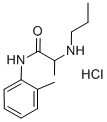
What is Propitocaine hydrochloride ?
Biological Functions
Prilocaine hydrochloride (Citanest) is an amide anesthetic whose onset of action is slightly longer than that of lidocaine; its duration of action is comparable. Prilocaine is 40% less toxic acutely than lidocaine, making it especially suitable for regional anesthetic techniques. It is metabolized by the liver to orthotoluidine, which when it accumulates, can cause conversion of hemoglobin (HB+++ to methemoglobin (HB+++. Oxygen transport is impaired in the presence of methemoglobinemia. Treatment involves the use of reducing agents, such as methylene blue, given intravenously, to reconvert methemoglobin to hemoglobin.
Side Effects
Common adverse reactions include bradycardia, hypotension, urticaria, edema, anaphylactoid reactions, lightheadedness, nervousness, euphoria, confusion, dizziness, drowsiness, tinnitus. The safety and effectiveness of prilocaine depend on proper dosage, correct technique, adequate precautions, and readiness for emergencies.
The Uses of Propitocaine hydrochloride
Propitocaine hydrochloride is a local anesthetic of the amino amide type,it is often used in dentistry. Prilocaine is also often combined with lidocaine as a preparation for dermal anesthesia (lidocaine/pril ocaine or EMLA), for treatment of conditions like paresthesia.
Synthesis
The synthetic method includes the following steps that a, ortho-toluidine is added into dichloromethane, alpha-propionyl chloride is dropwise added at the room temperature, and the reaction lasts for 2-3 h at the temperature of 15 DEG C-25 DEG C, acid solution washing is performed on the obtained reaction liquid, then, aqueous alkali washing is performed on the obtained reaction liquid, water is added to an organic layer to separate solids out, and then propitocaine hydrochloride midbody is obtained through filtration; b, the propitocaine hydrochloride midbody obtained in the step a is added into n-propylamine, reflux is heated for 5-7 h, after the reaction is ended, concentrated hydrochloric acid is added to adjust the PH to be 1-2, white solids are separated out and are refined through ethyl alcohol of 95%, and therefore the propitocaine hydrochloride is obtained.
Properties of Propitocaine hydrochloride
| Melting point: | 168-170°C |
| storage temp. | 2-8°C |
| solubility | Freely soluble in water and in ethanol (96 per cent), very slightly soluble in acetone |
| form | neat |
| color | White to Off-White |
| Merck | 14,7743 |
| InChI | InChI=1S/C13H20N2O.ClH/c1-4-9-14-11(3)13(16)15-12-8-6-5-7-10(12)2;/h5-8,11,14H,4,9H2,1-3H3,(H,15,16);1H |
| CAS DataBase Reference | 1786-81-8(CAS DataBase Reference) |
Safety information for Propitocaine hydrochloride
Computed Descriptors for Propitocaine hydrochloride
| InChIKey | BJPJNTKRKALCPP-UHFFFAOYSA-N |
| SMILES | C1(=CC=CC=C1C)NC(=O)C(C)NCCC.Cl |
Propitocaine hydrochloride manufacturer
Acute Research
New Products
Cis-Tosylate Dibenzo[b,f][1,4]thiazepin-11(10H)-one 1,2,3,9-Tetrahydro-9-Methyl-4H-Carbazole-4-One Dibenzoyl-L-tartaric acid Anhydrous (Resolution Reagent) N-BOC-piperidine-4-carboxylic acid 1-Benzhydrylazetane-3-carbonitrile AMINO-(3-CHLORO-PHENYL)-ACETIC ACID 2-(2-Chlorophenyl)glycine (±)-amino(2-fluorophenyl)acetic acid 8-oxa-1,3-diazaspiro[4.5]decane-2,4-dione BENZOIC ACID-D5 TRIFLOURO ACETICACID-D METHANE SULFONIC ACID-D4 PHOSPORIC ACID-D3 85 W% IN D2O TOLUENE-D3 BENZENE-D6 1-Acetyl-4-(4-hydroxyphenyl)piperazine 1-(3-Chlorophenyl)piperazine hydrochlorideRelated products of tetrahydrofuran


You may like
-
 Prilocaine hydrochloride 1786-81-8 99%View Details
1786-81-8 -
 Prilocaine HCL 98%View Details
1786-81-8 -
Prilocaine Hydrochloride CAS 1786-81-8View Details
1786-81-8 -
Prilocaine HCl >98% (HPLC) CAS 1786-81-8View Details
1786-81-8 -
Prilocaine HCl 98% (HPLC) CAS 1786-81-8View Details
1786-81-8 -
Prilocaine HCl 95.00% CAS 1786-81-8View Details
1786-81-8 -
 Prilocaine Hcl Powder, 25Kg DrumView Details
1786-81-8 -
 Prilocaine Hcl PowderView Details
1786-81-8